
Ever stood at your kitchen surface and felt something was slightly off, but could not pinpoint exactly what? Chances are, a measurement somewhere was not quite suited to you.
From the vertical rise of your surface to how far it stretches toward you, how long it spans across your walls, and how chunky the slab itself should be, every figure carries real consequences.
Along the way, you will also discover how to take precise readings like a professional, sidestep the sizing blunders that catch most buyers off guard, and tailor each specification to your unique lifestyle.
Sound useful? Let us get straight into the numbers that matter most.
What Are the Standard Kitchen Counter Dimensions?
Getting your kitchen counter dimensions right from the start saves you from costly corrections later. Here’s a quick breakdown of the measurements that matter.
1. Standard Kitchen Counter Height: The standard height for residential kitchen countertops is 36 inches (91.44 cm), which aligns with standard cabinet heights and suits most adults comfortably.
2. Standard Kitchen Counter Depth: The standard countertop depth is 25.5 inches, designed to accommodate 24-inch base cabinets while providing a practical front overhang.
3. Standard Kitchen Counter Width or Length: Width varies by layout. In most kitchens, countertop width is 25–26 inches, matching the base cabinet depth plus a small overhang.
4. Standard Countertop Thickness: Most stone countertops, such as quartz and porcelain, come in around 1.25 inches thick, while ultra-thick designs can reach 2 inches through edge lamination.
Before diving into each measurement individually, it helps to start with the one dimension that affects your daily comfort the most: how high your counter sits from the floor.
Standard Kitchen Counter Height
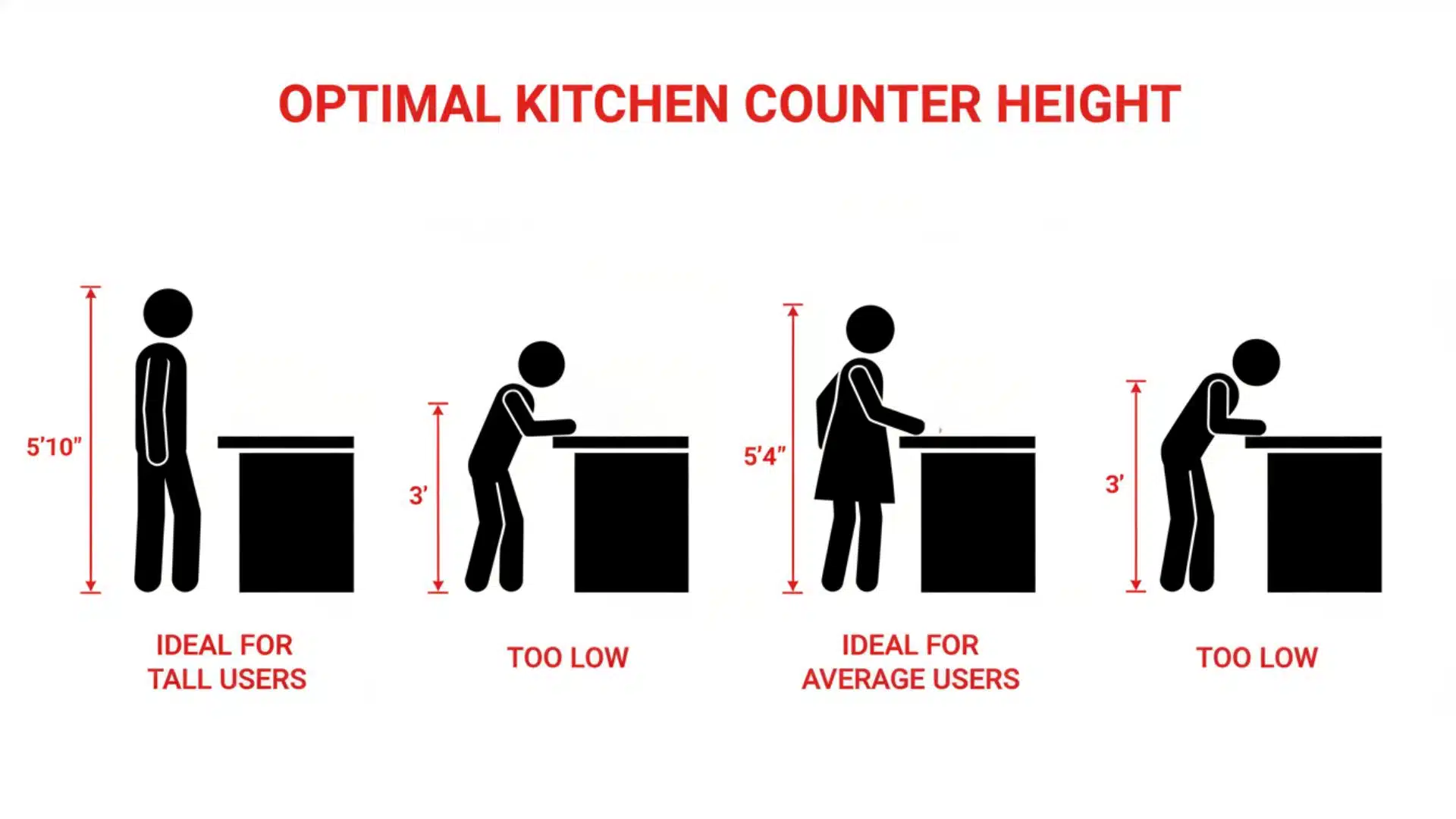
alt text: Infographic showing optimal kitchen counter height for tall and average users.
The 36-inch standard originated from a 1940s University of Illinois study, based on the average height of women at the time, around 5 feet 3 inches.
1. Why 36 Inches Works:
- It allows adults to maintain a neutral posture, minimizing bending or hunching during food prep and dishwashing.
- Most appliances, such as dishwashers, are designed to fit beneath this height for a seamless, cohesive look.
How is the Height Is Achieved? Base cabinets stand at 34.5 inches. Add a standard 1.5-inch countertop material on top, and you reach exactly 36 inches. |
2. When to Go Higher or Lower:
- Taller users (6 feet+): 38 to 39 inches works better
- Shorter users: 32 to 34 inches reduces strain
- ADA guidelines recommend a maximum of 34 inches for wheelchair-accessible kitchens
- Baking stations: 32 to 33 inches is more comfortable
Designer Tip: If multiple people of different heights share the kitchen, consider building one section of the counter at a lower height, around 32 to 33 inches, as a dedicated prep zone.
Height tells you how comfortable you will feel working at your counter, but depth determines how much usable workspace you actually have to cook, prep, and organize.
Why Most Kitchen Counters Are About 25 to 26 Inches Deep
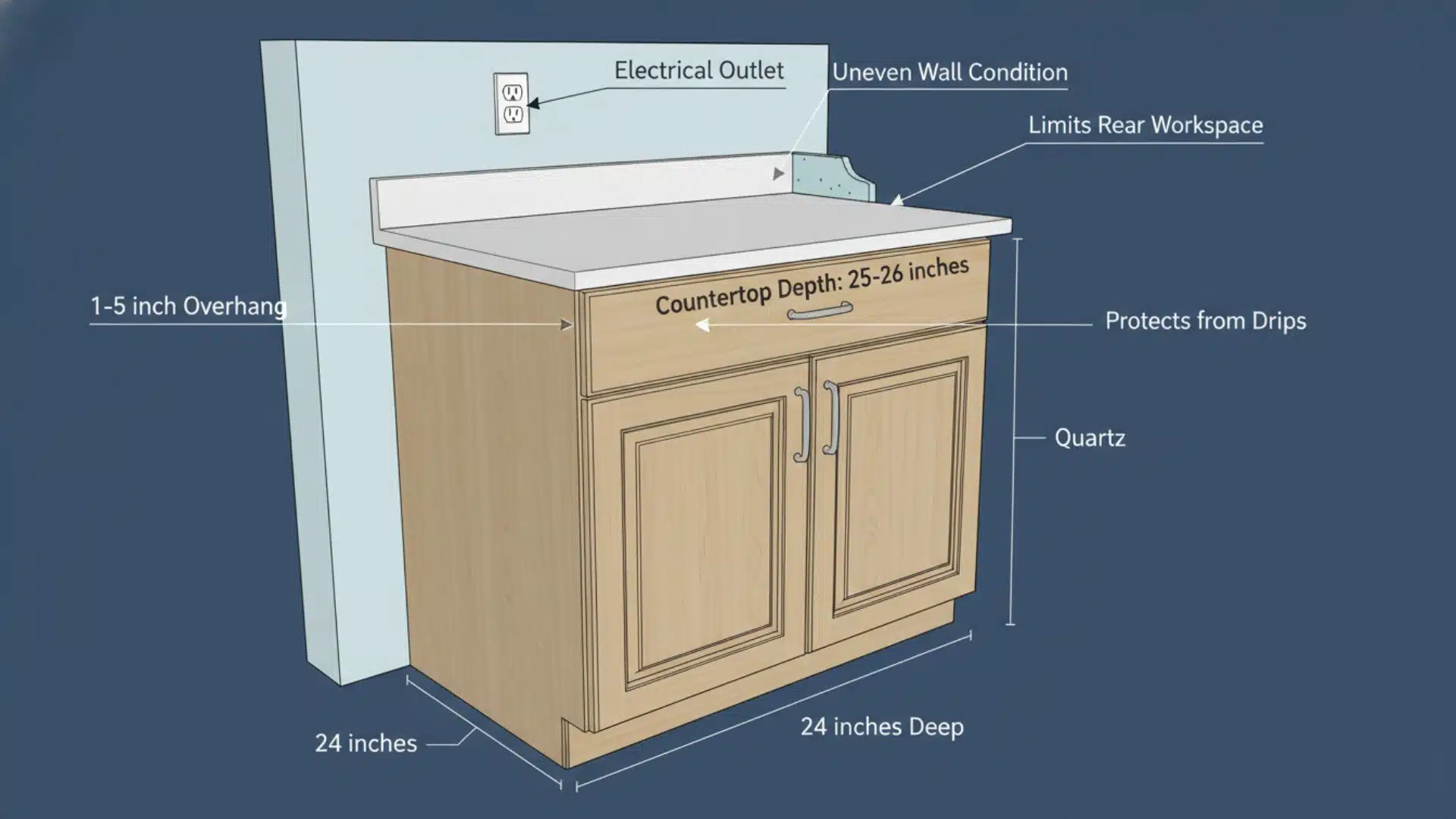
alt text: Diagram showing kitchen countertop depth, cabinet size, overhang, and wall spacing.
Standard kitchen counter depth sits between 25 and 26 inches, and this number is closely tied to the size of the base cabinets sitting beneath it.
1. The Difference Between Cabinet Depth and Countertop Depth:
- Standard base cabinets are 24 inches deep
- The countertop extends slightly beyond the cabinet edge, adding a 1 to 1.5-inch overhang
- This overhang protects cabinet doors from drips and makes standing at the counter more comfortable
2. How Backsplash and Wall Conditions Can Affect Usable Depth:
- A thick backsplash tile installation can reduce usable counter depth by half an inch or more
- Uneven or bulging walls can push the countertop forward, slightly reducing the rear workspace
- Outlets and plumbing fixtures mounted on the wall can limit how far back items can be placed
Designer Tip: Always measure your usable depth after the backsplash is installed, not before. What looks like 25 inches on paper can feel noticeably tighter once tiles and grout are in place.
With depth sorted, the next dimension worth understanding is counter width and how total length affects your kitchen’s overall workflow.
Kitchen Counter Width: What the Numbers Along Your Wall Actually Mean?
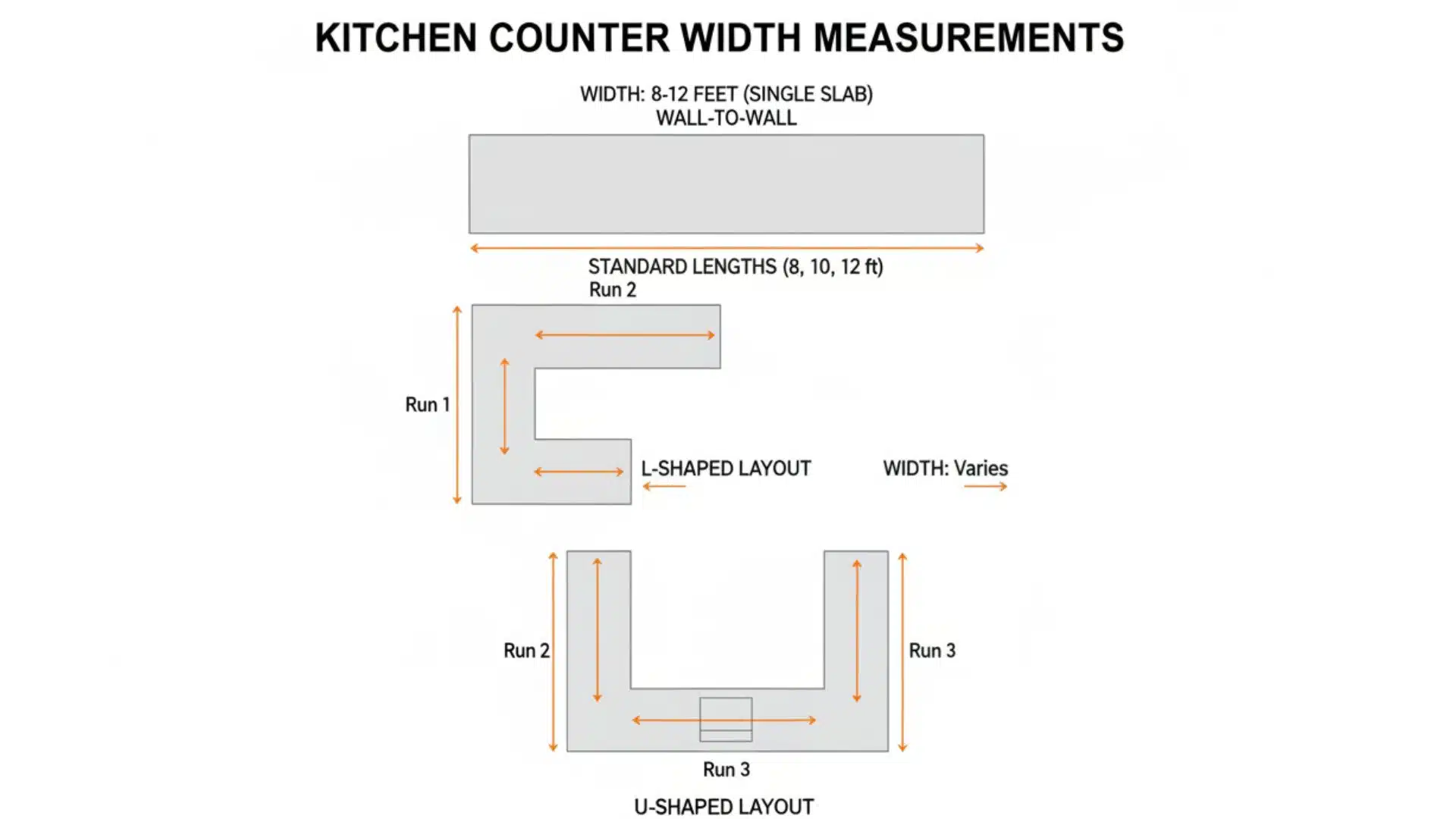
alt text: Diagram showing kitchen counter width measurements for straight, L-shaped, and U-shaped layouts.
Width is measured wall-to-wall along each counter run, not front to back. It determines how much continuous work surface you have available.
1. Standard Lengths for Countertop Runs:
- Single prefabricated slabs typically come in lengths of 8, 10, and 12 feet
- Most kitchens require multiple sections joined together to cover the full run
2. How Width Changes by Kitchen Layout:
- Straight counters: one continuous run, measured wall to wall
- L-shaped kitchens: two separate runs meeting at a corner, each measured independently
- U-shaped kitchens: three connected runs requiring precise corner measurements on both sides
3. When Custom Sizing Is Needed:
- Unusually long or short wall runs
- Angled or curved kitchen layouts
- Oversized appliances that interrupt the counter run
Designer Tip: For U-shaped and L-shaped kitchens, always account for corner cabinet space when calculating total counter width.
Knowing your counter width sets the foundation, but thickness is the final measurement that ties together both the look and durability of your countertop material.
Standard Countertop Thickness: How Much Does It Actually Matter?
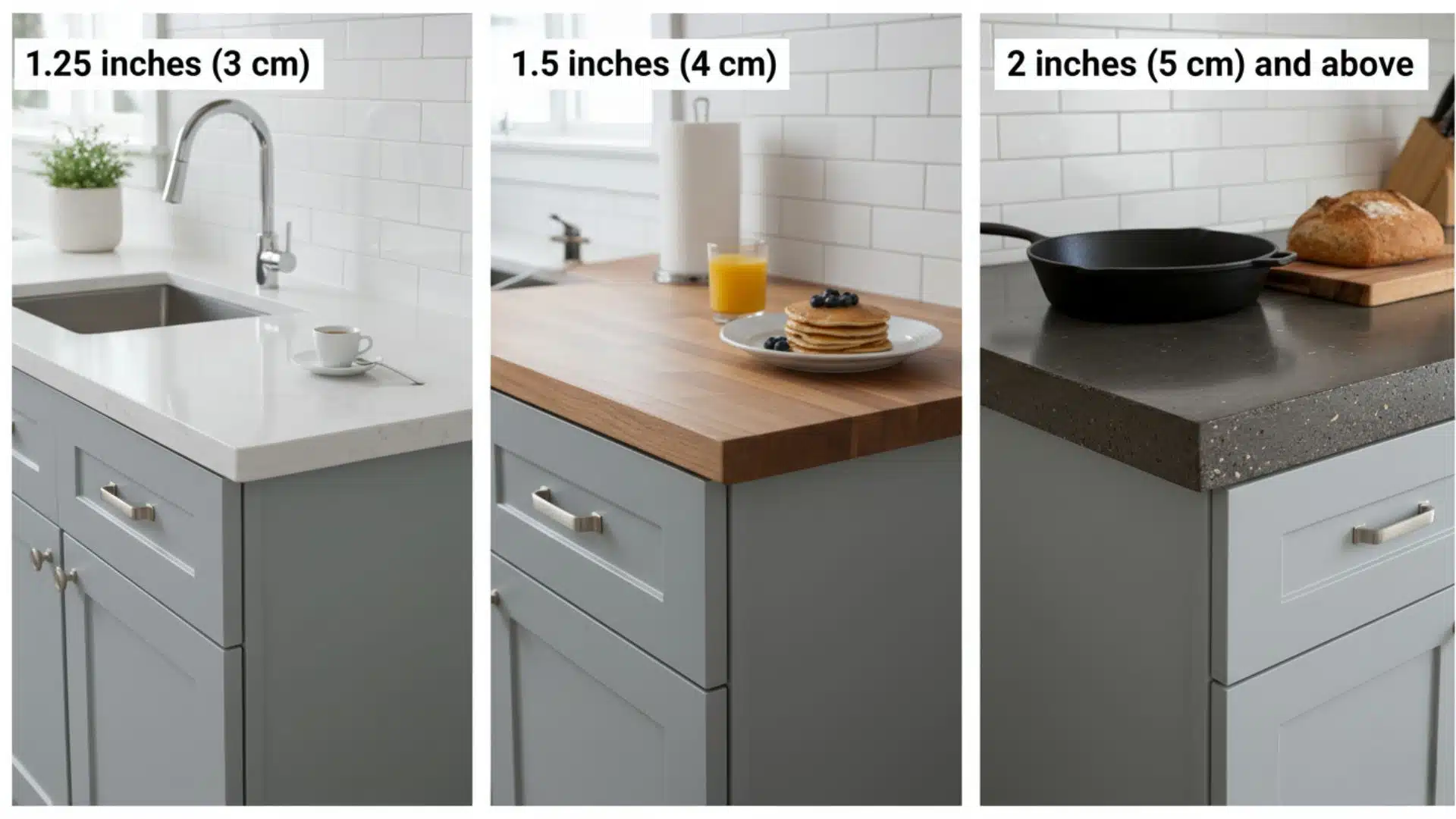
alt text: Comparison of kitchen countertop thickness options: 1.25 inches, 1.5 inches, and 2 inches or more.
Countertop thickness influences the overall height, visual weight, and structural strength of your kitchen surface.
1. Common Thickness Options:
- 1.25 inches (3 cm): Most popular, suits quartz, granite, and marble
- 1.5 inches: Standard for laminate countertops
- 2 inches and above: Used for decorative edge profiles or concrete slabs
2. How Thickness Affects Final Counter Height:
- A thicker slab raises the finished counter height beyond the standard 36 inches
- Switching from 1.25 to 2 inches adds noticeable height without cabinet adjustments
- Always factor in slab thickness before finalizing base cabinet height
3. Choosing Thickness Based on Material and Style:
- Thin slabs (1 cm): Sleek, modern kitchens with light stone
- Mid-range (1.25 to 1.5 inches): Most everyday kitchens and materials
- Thick slabs (2 inches+): Luxury or farmhouse-style kitchens seeking a bold, substantial look
Designer Tip: If you love the look of a thick countertop but want to manage costs, ask your fabricator about a mitered edge detail. It gives the illusion of a 2-inch slab using standard thickness material.
Getting your measurements right before ordering is just as important as choosing the right material, since even a small error can lead to costly refabrication.
How to Measure Kitchen Counter Dimensions Correctly?
Before you call your fabricator or head to the showroom, grab a tape measure and carefully run through each of these key dimensions.
| Measurement | What to Measure | Key Tip |
|---|---|---|
| Height | Floor to top of base cabinet, then add countertop thickness | Measure at multiple points, as floors are rarely perfectly level |
| Depth | Front edge of the cabinet to the wall | Measure after backsplash installation for an accurate usable depth |
| Length | Wall-to-wall along each counter run | Measure at both front and back edges, as walls may not be parallel |
| Overhang | Cabinet edge to countertop front edge | Standard overhang is 1 to 1.5 inches for base cabinets |
With accurate measurements in hand, the next step is to dig into the most common dimension mistakes a person makes, so you can avoid them before they become expensive problems.
Common Mistakes When Choosing Counter Dimensions
Even experienced renovators get these wrong. Here is what to watch out for and how to correct it.
1. Confusing Cabinet Size With Countertop Size
- Problem: Treating cabinet depth as countertop depth, resulting in insufficient workspace.
- Fix: Always add 1 to 1.5 inches of overhang to your cabinet measurement when planning countertop depth.
2. Ignoring Appliance Depth
- Problem: Ignoring appliance depth, causing refrigerators or ranges to stick out beyond the counter edge.
- Fix: Measure every appliance before finalising counter depth and cross-check against your layout plan.
3. Not Planning Enough Overhang for Seating
- Problem: Skipping the seating overhang on islands, leaving no comfortable legroom for stools.
- Fix: Allow a minimum of 12 inches of overhang for standard counter-height seating.
4. Choosing an Island That Blocks Movement
- Problem: Choosing an oversized island that cuts into walkway space and blocks movement.
- Fix: Maintain at least 42 to 48 inches of clearance on all sides of the island.
Now that you have a clear picture of every key measurement, from height and depth to width and thickness, it is time to bring it all together before you make any final decisions.
Final Thoughts
Choosing the right kitchen counter dimensions makes everyday cooking, prepping, and cleaning far more comfortable.
The standard measurements of about 36 inches in height and roughly 25 to 26 inches in depth work well for most kitchens because they align with cabinet sizes, appliances, and natural working posture.
If you are planning a kitchen renovation or new installation, take a few minutes to review your layout and measurements again.
Does your counter height feel comfortable? Do you have enough prep space? Share your thoughts or questions in the comments. Your experience might help someone else plan their kitchen.
Frequently Asked Questions
Is It Better to Have Thick or Thin Countertops?
Honestly, it comes down to personal taste. Thick countertops make a strong design statement while thin slabs keep things light and refined. Either way, the material quality matters most.
What Type of Countertop Is the Least Maintenance?
If ease of care is your priority, Quartz wins hands down. It skips the sealing process entirely and handles daily kitchen demands without demanding much attention in return.
Are All Kitchen Counters 36 Inches High?
No, 36 inches is simply the most common measurement. Taller users often prefer 38 to 39 inches, while accessible kitchens designed for wheelchair users typically sit at 34 inches or lower.