Planning a new roof? You’re stuck choosing between rafters and trusses. Most builders face this same decision, and it’s not easy.
Your choice affects three big things: how much you’ll spend, how long construction takes, and what you can do with your attic space. Pick the wrong one, and you’ll waste money or limit your home’s potential.
This guide solves that problem.
You’ll learn what rafters and trusses actually are, how they differ in strength and cost, and which one fits your specific project. We’ll cover installation speed, design flexibility, and load capacity, everything you need to choose confidently.
By the end, you’ll know exactly which roof framing system works best for your build.
What Are Rafters?
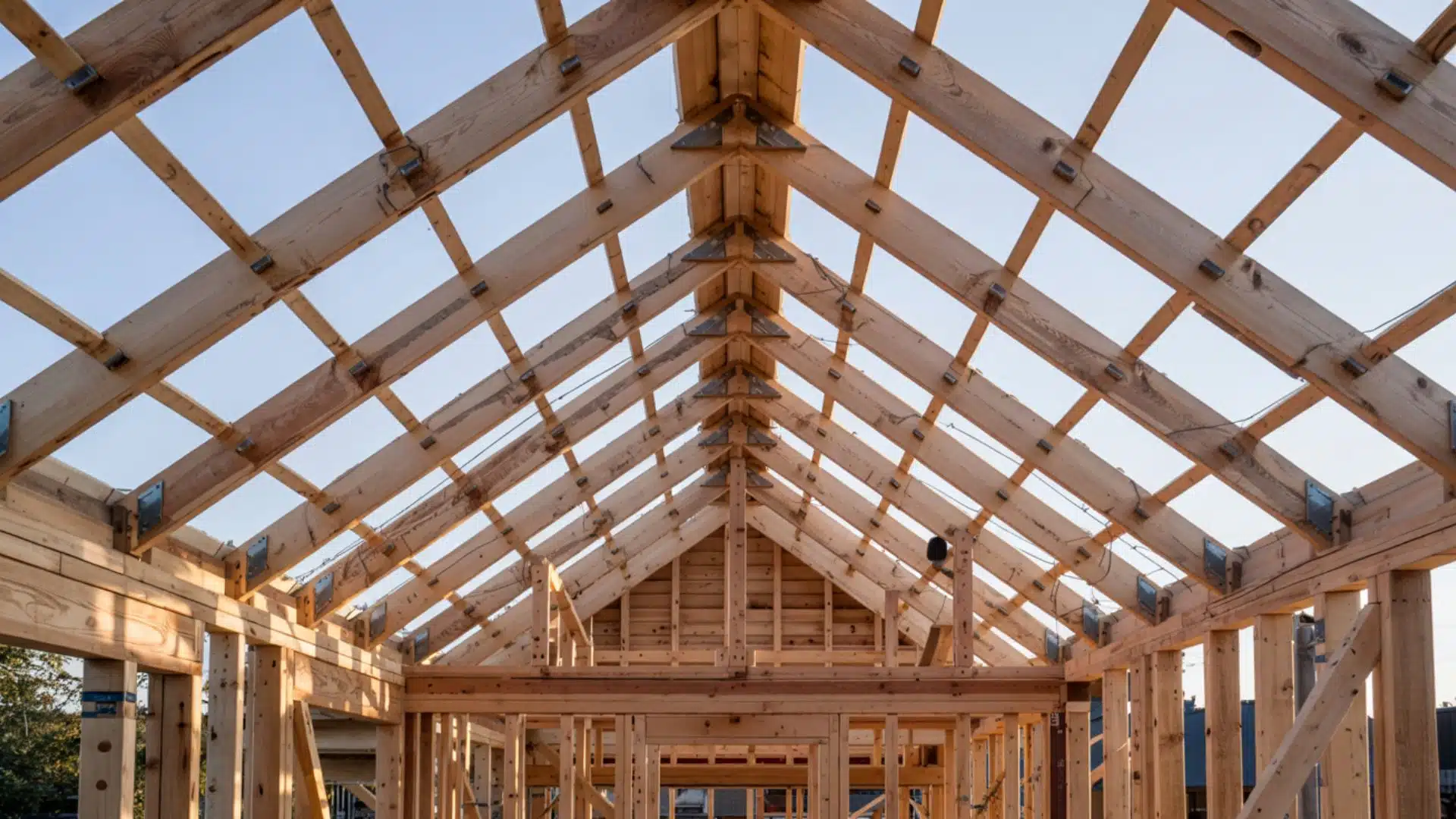
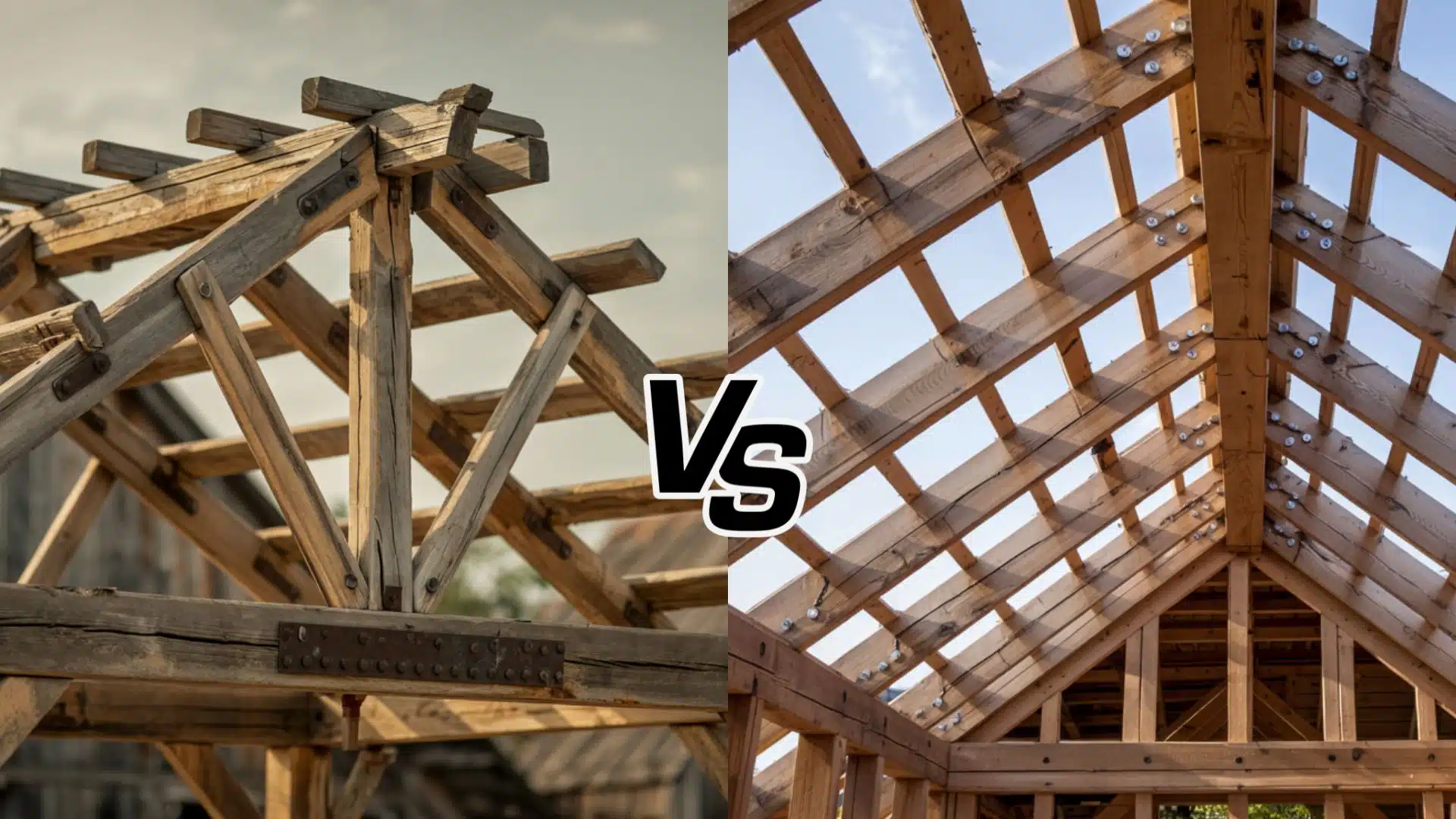
Rafters are wooden beams that run from the top of your roof down to the walls. They’ve been used in home construction for centuries and remain popular today.
Think of rafters as individual pieces of lumber arranged in a triangular pattern. A carpenter cuts each piece on-site and nails them together, one by one. This method is called “stick framing.”
How Rafters Are Built?
The construction process starts with the ridge board at the peak of your roof.
Carpenters then attach rafters from this ridge board down to the wall plates on opposite sides. Each rafter must be measured, cut, and secured individually.
The process requires:
- Ridge board (the horizontal beam at the roof peak)
- Rafters (angled beams running from the ridge to the walls)
- Ceiling joists (horizontal supports that tie the rafters together)
- Collar ties (braces that prevent rafters from spreading)
Most rafters use 2×8, 2×10, or 2×12 dimensional lumber. The exact size depends on the span length and expected snow or wind loads in your area.
When Rafters Make Sense?
- Custom homes – You can create cathedral ceilings, exposed beams, or unique roof angles without factory limits.
- Renovation projects – Matching existing roof styles becomes easier when building piece by piece on-site.
- Remote locations – Transporting individual lumber boards is simpler than delivering large prefabricated trusses.
- Future expansion plans – Adding dormers, skylights, or room extensions later requires less structural engineering.
- Open attic space needs – No internal webbing blocks the area, giving you full storage or living space.
Pros and Cons of Roof Rafters
Rafters offer unmatched flexibility and customization for roofs, making them ideal for unique designs, vaulted ceilings, and open attic spaces.
| Pros of Rafters | Cons of Rafters |
|---|---|
| Flexible for design changes or vaulted ceilings | Higher cost and longer build time |
| Creates cathedral ceilings, exposed beams, or unique angles | Requires skilled carpenters |
| Easier to build in remote or tight-access sites | Limited span length (typically |
| Provides open attic space for storage or future living | Heavier structure needing stronger foundations |
| Easier future remodels or extensions (dormers, skylights) | More timber increases material costs |
Rafters are best for owners seeking design flexibility and future adaptability, but careful planning is needed for cost, labor, and structural support considerations.
What Are Trusses?
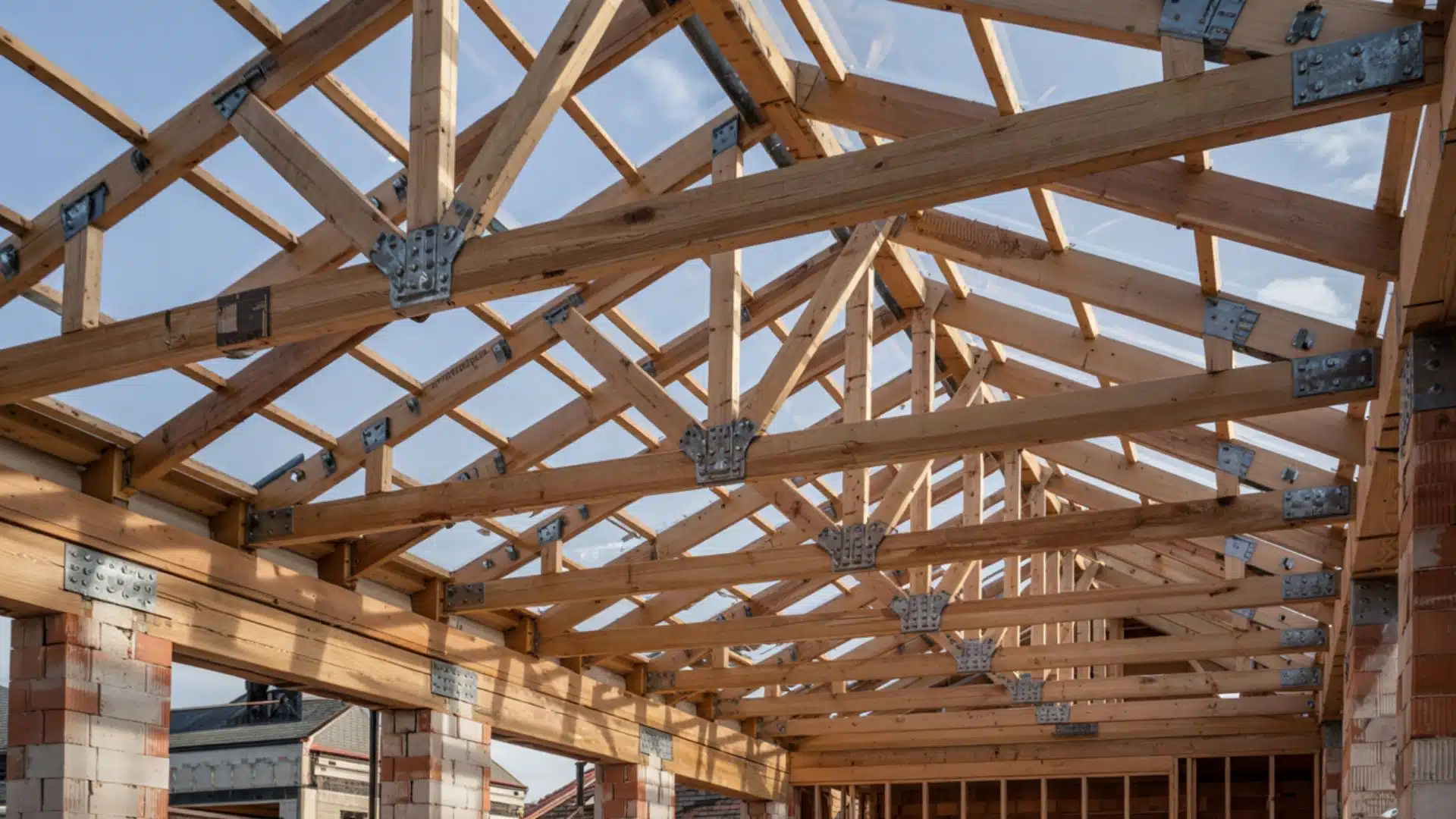
Trusses are factory-built frames that arrive at your job site ready to install. Engineers design them using computer software, and machines build them with precision.
Each truss forms a triangle, the strongest structural shape in construction. This triangle consists of three main parts working together.
Trusses Components
- Top Chord: The sloped boards forming your roof’s outer shape. These pieces handle downward weight from shingles, snow, and wind.
- Bottom Chord: The horizontal board running along the bottom. This often doubles as your ceiling frame for rooms below.
- Webbing: Diagonal and vertical pieces connecting top and bottom chords. These create the internal triangle pattern that gives trusses their strength.
- Metal Connector Plates: Galvanized steel plates with teeth press into wood at each joint. These create stronger connections than nails alone.
How Trusses Are Made?
Factory production starts with engineering calculations. Software determines the exact size and placement of each piece based on your roof span, pitch, and expected loads.
Machines cut the lumber to precise measurements. Workers assemble the pieces on large tables, and hydraulic presses force the metal plates into place.
Quality control happens before shipping. Each truss undergoes inspection to verify compliance with engineering specifications.
With a clear learning of trusses, it’s time to compare rafters and trusses side by side to see which system best fits your project.
Pros and Cons ofTrusses
Trusses provide fast, cost-effective roof framing with precise factory-built quality, making them ideal for standard designs and open floor plans. They offer efficiency but limit attic space and future modification flexibility.
| Pros of Trusses | Cons of Trusses |
|---|---|
| Faster installation—roof framed in 1–2 days | Limited attic space due to webbing |
| Lower overall cost (20–50% cheaper than rafters) | Harder to modify after installation |
| Longer spans allow open floor plans | Requires transport and lifting equipment |
| Factory precision ensures consistent quality | Lead time for fabrication (2–6 weeks) |
No perfect choice exists. Your priorities determine which system fits better. Consider what matters most for your specific project before committing to either approach.
Rafters vs Trusses: A Side-by-Side Comparison
Choosing between these two systems affects your budget, timeline, and finished space. Here’s how they stack up against each other.
Construction
- Rafters – Built piece by piece on your job site using individual lumber boards. Carpenters measure, cut, and nail components together by hand.
- Trusses – Manufactured in a factory using computer designs and precision machinery. They arrive at your site already assembled and ready to install.
Installation Speed
- Rafters – Take 1-2 weeks to frame a typical residential roof. Weather delays and on-site cutting slow down the process.
- Trusses – Frame most residential roofs in just 1-2 days. Crane lifting and quick positioning make installation fast.
Cost
- Rafters – Higher labor costs due to extended construction time and skilled carpenter requirements. Total project costs run 20-50% more than trusses.
- Trusses – Lower overall expenses thanks to factory efficiency and faster installation. Material costs may be higher, but labor savings make them cheaper.
Design Flexibility
- Rafters – Easily modified on-site to create custom angles, cathedral ceilings, or unique features. Changes happen quickly without waiting for new fabrication.
- Trusses – Limited to the original factory design once manufactured. Modifications require engineer approval and often aren’t possible after installation.
Attic/Storage Space
- Rafters – Provide completely open space between roof and ceiling. Perfect for storage, mechanical systems, or future living areas.
- Trusses – Internal webbing fills the attic space, blocking storage and access. Converting to living space becomes nearly impossible.
Load-Bearing Capacity
- Rafters – Handle moderate loads depending on lumber size and spacing. Performance varies based on carpenter installation quality.
- Trusses – Engineered for high load efficiency with precise weight distribution. Computer calculations ensure consistent strength across all units.
Material Use
- Rafters – Require 20-30% more lumber than equivalent truss systems. Extra material adds weight and increases costs.
- Trusses – Use less wood through optimized engineering and efficient design. Factory precision reduces waste significantly.
Span Capability
- Rafters – Typically span up to 30 feet before needing support posts. Longer spans require larger, more expensive lumber or interior walls.
- Trusses – Easily span 40-60 feet or more without interior support. Custom designs can reach 100+ feet for commercial buildings.
Best Suited For
- Rafters – Ideal for custom homes, small buildings, or complex roof designs. Works well when design flexibility matters most.
- Trusses – Perfect for standard roof designs, large buildings, or budget-focused projects. Best choice when speed and cost efficiency are priorities.
This side-by-side comparison highlights the key differences between rafters and trusses, helping you choose the best option for your roof design, budget, and construction needs.
Beyond cost and design, another critical factor is how rafters and trusses handle load-bearing and overall structural strength.
Strength Comparison: Trusses vs Rafters Load Capacity
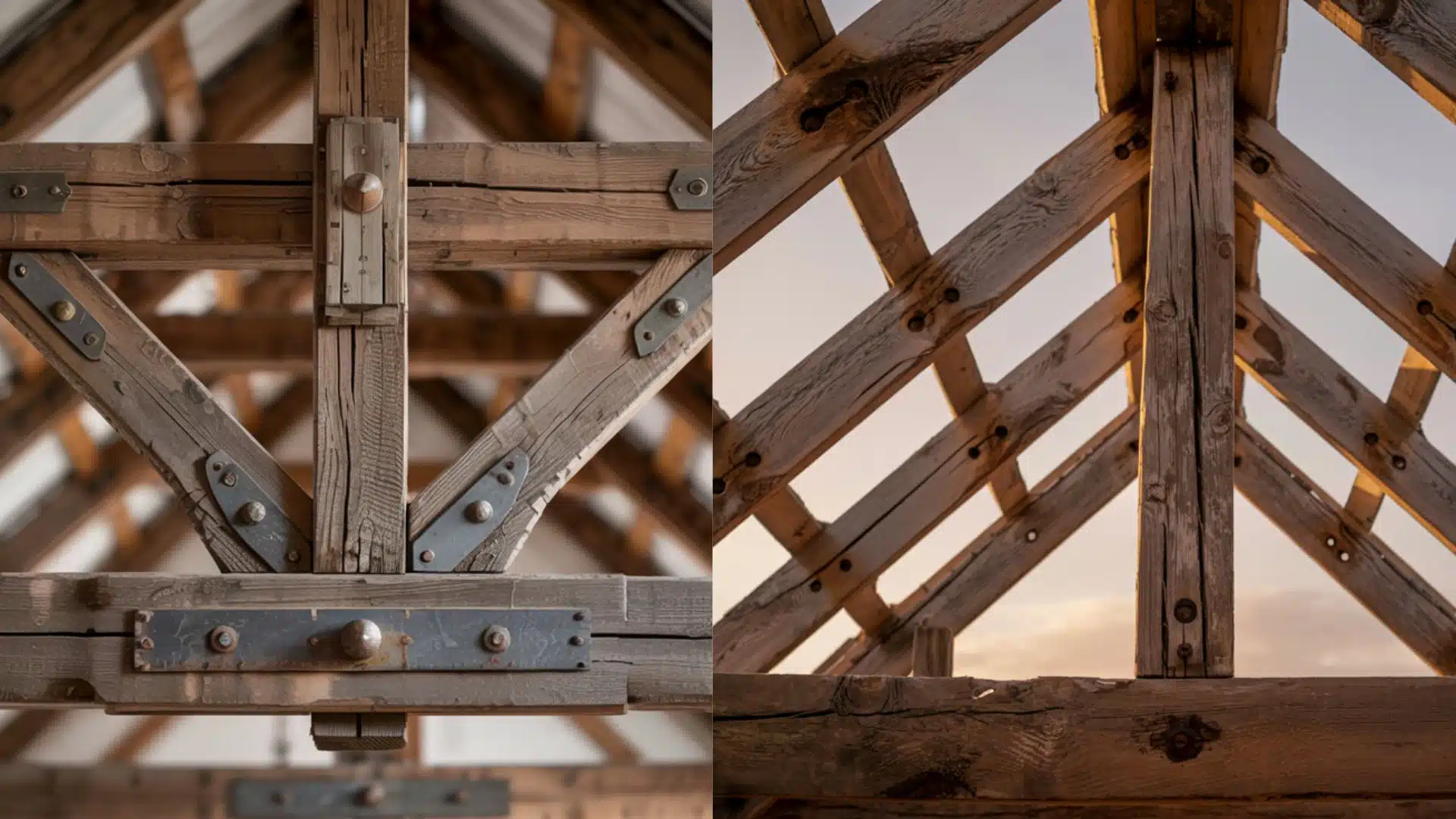
Learning how each system handles weight helps you make an informed choice. Both options can safely support your roof, but they work differently.
How Trusses Distribute Weight?
The triangle shape gives trusses their strength. When weight pushes down on the top chord, the webbing redirects that force outward to the walls.
Engineers calculate exact forces for each truss. Computer models test how the design will perform under snow loads, wind pressure, and the roof’s own weight.
Factory construction ensures each truss matches these calculations precisely. The metal connector plates create joints that won’t loosen or shift over time.
How Rafters Handle Loads?
Rafters work more simply. Each beam acts like a bridge, carrying weight from where it sits down to the walls on either side.
Ceiling joists play a vital role. They tie opposite rafters together, preventing walls from spreading outward under the roof’s weight.
Larger rafters can handle heavier loads, but there are limits. Beyond about 30 feet, even the biggest dimensional lumber starts to struggle without additional support.
Span Length Capabilities
Standard trusses regularly span 40 to 60 feet without interior support walls. Rafters typically max out around 24 to 30 feet for residential construction.
The load-bearing performance of trusses vs. rafters is clearly evident in large buildings. Trusses consistently handle more weight across longer distances.
Cost Comparison: Which Is More Affordable?
Money matters in construction. Knowing the full cost picture helps you budget accurately and avoid surprises.
Here’s a detailed breakdown of what you’ll actually pay:
| Cost Category | Rafters | Trusses |
|---|---|---|
| Material Cost (per sq ft) | $2.50 – $4.00 | $3.00 – $6.00 |
| Labor Cost (typical home) | $6,000 – $15,000 | $2,000 – $5,000 |
| Installation Time | 1-2 weeks | 1-2 days |
| Engineering Fees | Usually not required | $500 – $2,000 |
| Equipment Rental | Minimal | $500 – $1,500 (crane) |
| Delivery Charges | Low (lumber trucks) | $200 – $800 |
| Total Cost (2,000 sq ft roof) | $16,000 – $20,000 | $13,000 – $16,000 |
| Typical Savings with Trusses | 20-50% more expensive | 20-50% cheaper overall |
What does this mean for Your Project?
While trusses have higher material costs per square foot, labor savings make them 20-50% cheaper overall. Installation takes days instead of weeks, cutting labor expenses significantly.
Rafters cost less in materials but require more lumber total and skilled carpenters working longer. These labor hours quickly exceed any material savings.
Choosing Between Rafters and Trusses: How to Decide?
Making the right choice requires looking at your specific situation. These factors will guide you to the best option.
- Assess Complexity: Trusses suit simple roofs; rafters fit custom angles; for complex roofs, compare both.
- Consider Timeline: Trusses save time on tight schedules; rafters work when timelines are flexible, but trusses need lead time.
- Evaluate Budget: Trusses are usually cheaper for standard roofs, but compare all costs: materials, labor, equipment, engineering, and delivery based on your project.
- Plan for Future Changes: Use rafters for easier renovations or additions; trusses work when no future modifications are expected.
- Consult Professionals: Ask engineers, contractors, and architects to assess your design and advise on choosing between trusses and rafters.
Conclusion
The roof rafter vs truss decision comes down to your priorities. Trusses deliver speed, cost savings, and impressive trusses vs rafters load-bearing capacity for longer spans compared to rafters.
They’re ideal for standard designs and tight budgets. Rafters provide design flexibility, open attic space, and easier future modifications; perfect for custom homes.
Consider your timeline, budget, site access, and whether you need usable attic space. Both systems build safe, durable roofs when properly installed.
Review your project requirements carefully, get quotes for both options, and consult your structural engineer. The right choice becomes clear when you match the framing method to your specific needs.