You called three painters. You got three wildly different quotes. Now you have no idea which one is fair, or what the extra $2,000 difference actually covers.
That’s the most common situation homeowners face when planning a paint job. The numbers feel random because nobody explains what’s behind them.
Most owners pay between $2,000 and $6,000 for interior painting and $1,800 to $8,500 for exterior work. The average interior job runs around $2,022 according to 2026 data from Angi. The average exterior job sits at roughly $3,177.
Those are averages. Your home may end up costing more or less, depending on its size, surface condition, and the painter you hire.
Here’s a quick overview by project type:
| Project Type | Average Cost | Typical Range |
|---|---|---|
| Interior (full home) | $2,022 | $965 – $3,089 |
| Exterior (full home) | $3,177 | $1,800 – $8,500 |
| Interior per sq ft | $2.75 | $2 – $6 |
| Exterior per sq ft | $2.75 | $1.50 – $4 |
| Both interior + exterior | $5,000 – $10,000+ | Varies by size |
Cost to Paint a House by Size
Home size is the single biggest driver of total cost. More wall surface means more paint and more hours on the job. Here’s what most homeowners pay based on square footage:
| Home Size | Interior Cost | Exterior Cost |
|---|---|---|
| 1,000 sq ft | $2,000 – $4,000 | $1,800 – $3,500 |
| 1,500 sq ft | $3,000 – $6,000 | $2,500 – $4,500 |
| 2,000 sq ft | $4,000 – $8,000 | $4,000 – $8,000 |
| 3,000+ sq ft | $6,000 – $15,000 | $5,000 – $12,000+ |
Keep in mind that painters measure paintable wall area, not floor area. A home with 9-foot ceilings has roughly 15% more wall surface than one with 8-foot ceilings at the same square footage.
Also read: How Much Does It Cost to Paint a Room?
Factors That Affect the Cost to Paint a House
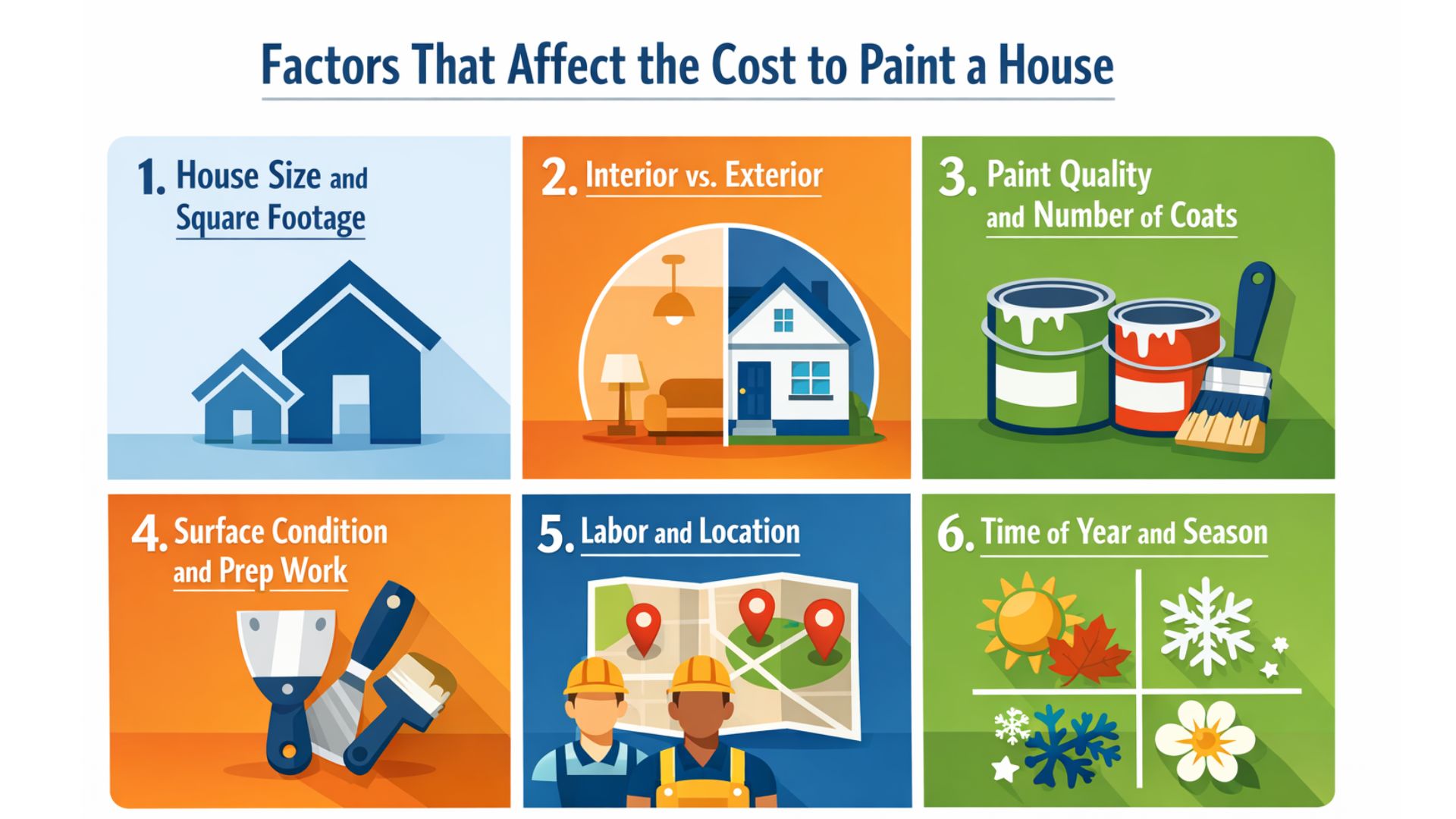
The final price of any paint job rarely comes down to a single factor. Here are the main things that push the number up or bring it down.
1. House Size and Square Footage
More square footage means more paint and more labor hours. Most painters charge $1.50 to $4.00 per square foot for exterior work and $2 to $6 per square foot for interior work.
A 1,000 sq ft home and a 3,000 sq ft home can differ by thousands of dollars, even with the same paint on the walls.
2. Interior vs. Exterior
Exterior jobs almost always cost more. The surfaces take more abuse from the weather. The prep work is heavier: power washing, scraping, caulking. Access is harder on two-story homes.
Interior jobs vary based on how many rooms you paint and whether you include ceilings, trim, and doors, or just walls.
If you plan to paint both inside and out, most contractors offer a bundled rate. You can save 10–15% compared to booking them separately.
3. Paint Quality and Number of Coats
- Budget paint: $20–$35 per gallon, usually needs 2–3 coats
- Mid-range paint: $40–$55 per gallon, covers in 2 coats
- Premium paint (Sherwin-Williams, Benjamin Moore): $50–$80+ per gallon, covers in 1–2 coats, and holds color for 5–7 years
The catch with budget paint? More coats mean more labor hours. A $20 gallon can cost more in total than a $55 gallon once you add up the extra time.
4. Surface Condition and Prep Work
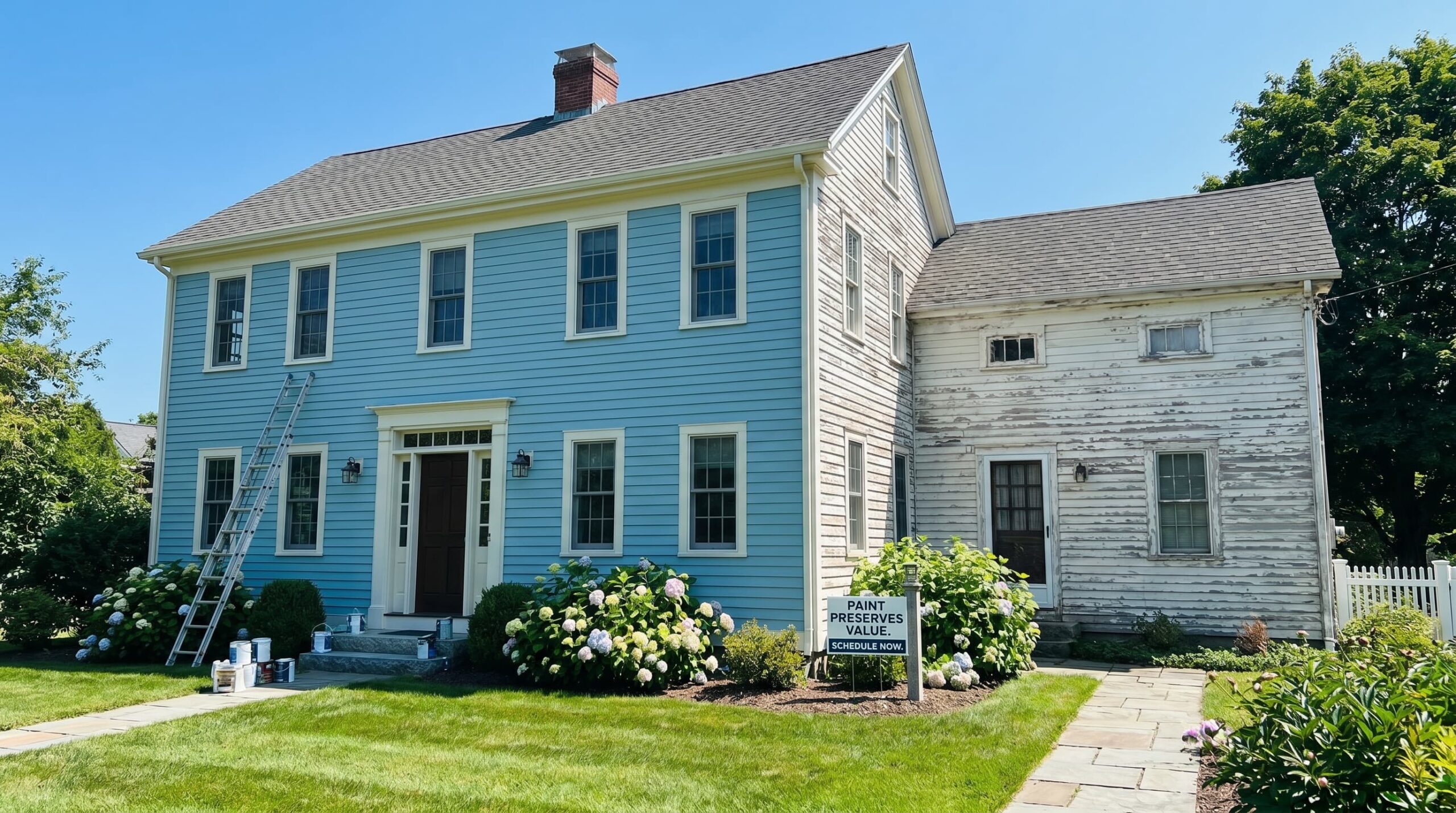
This is where quotes diverge the most. Clean, well-maintained walls need minimal prep. But walls with cracks, peeling paint, water stains, or old wallpaper need sanding, patching, and priming first.
Prep work adds $0.50 to $1.50 per square foot to your total. Homes with heavy prep needs can see their bill rise 20–30% above the base estimate.
Skipping prep saves money now. It costs double when the new paint peels within a year.
5. Labor and Location
A painter in New York or San Francisco charges $50 to $75 per hour. The same skill in a mid-sized city might run $25 to $40 per hour.
Urban areas and high-cost markets price 20–40% above the national average. This is one factor you can’t change, but you can time your project for the off-season when demand drops, and rates follow.
6. Time of Year and Season
Spring and early fall are peak painting seasons. Higher demand means higher rates and longer wait times.
Booking interior work in late fall or winter can save 10–15% on labor. Exterior work is weather-dependent; paint cures best between 50°F and 85°F with low humidity.
7. Siding Type (Exterior)
The material on your home’s exterior changes both the paint needed and the labor required.
If you are weighing a full siding replacement against a repaint, comparing the two costs side by side can help you decide.
| Siding Type | Cost per Sq Ft |
|---|---|
| Vinyl or aluminum | $1.00 – $3.00 |
| Wood | $1.50 – $5.00 |
| Brick | $2.50 – $5.00 |
| Stucco | $2.00 – $5.00 |
| Metal | $1.25 – $3.50 |
Brick and stucco are porous and absorb more paint. They often need a primer coat and may benefit from an elastomeric paint rather than a standard latex paint.
Interior House Painting Costs
Painting the inside of your home costs more than most people expect. Here is a full breakdown of what you will likely pay, room by room and surface by surface.
| Area / Surface | Cost Range | Notes |
|---|---|---|
| Full Interior (avg. home) | $1,000 – $3,500 | Includes labor and basic prep |
| Bedroom | $350 – $650 | Based on 130 – 200 sq ft |
| Living Room | $600 – $1,200 | Based on 250 – 400 sq ft |
| Kitchen / Bathroom | $150 – $400 | Smaller space, more detailed work |
| Hallway | $150 – $300 | Tight angles add time |
| Walls Only | $1.50 – $3.00/sq ft | Most budget-friendly option |
| Walls + Ceiling + Trim | $3.00 – $5.00/sq ft | Recommended for best results |
| Closets | $50 – $150 each | Per closet |
| Interior Doors | $75 – $150 each | Per door |
| Baseboards / Crown Molding | $1.00 – $3.00/linear ft | Varies by detail level |
Exterior House Painting Costs
Painting the outside of your home involves more than just walls. Here is a full breakdown of what you will likely pay, from the overall job down to every add-on.
| Area / Surface | Cost Range | Notes |
|---|---|---|
| Full Exterior (avg. home) | $1,500 – $12,000 | Includes labor and basic prep |
| Cost per Square Foot | $1.50 – $4.00/sq ft | Varies by surface and paint quality |
| Single-Story Home | $1,500 – $3,000 | Easy access, less labor |
| Two-Story Home | $3,000 – $6,000 | Ladders or lifts needed |
| Three-Story / Large Home | $6,000 – $12,000+ | Scaffolding often required |
| Ranch-Style Home | $1,200 – $2,800 | Low roofline, faster job |
| Victorian / Detailed Style | $4,000 – $10,000+ | Great detail, more labor hours |
| Exterior Trim | $1.00 – $2.50/linear ft | Varies by length and detail |
| Shutters | $25 – $75 per pair | Per set of shutters |
| Fascia Boards | $1.00 – $2.00/linear ft | Along roof edges |
| Garage Door (single) | $100 – $250 | Per door |
| Porch / Deck | $250 – $1,500 | Depends on size and condition |
| Scaffolding (difficult access) | $300 – $800 extra | Steep rooflines, slopes, narrow yards |
Why Difficult Access Costs More Not every home is easy to reach. If your house has steep rooflines, narrow side yards, or sits on a slope, painters need more time and equipment to do the job safely. |
Labor Cost vs Material Cost
When it comes to painting projects, many people tend to focus on the cost of paint, but labor is typically the bigger expense. Here’s a breakdown of where your money goes when you hire a painter:
Labor usually accounts for 70% to 85% of the total cost, while materials make up the remaining 15% to 30%. For example, on a $4,000 exterior painting job, labor could cost between $2,800 and $3,400.
Here’s how the costs break down:
- Labor (painter’s time): 70% – 85% of the total cost, typically $25 – $75 per hour per painter
- Paint (interior/exterior): 10% – 20%, ranging from $20 – $80 per gallon
- Primer: 3% – 5%, costing $15 – $50 per gallon
- Tape, rollers, brushes: 2% – 4%, totaling $20 – $100
- Caulk and sanding supplies: 1% – 3%, costing $10 – $50 in total
- Contractor markup on materials: 10% – 20% above retail prices, added to the material costs.
How Long Does It Take to Paint a House?
A professional crew of two to three painters can finish a full interior in 2 to 4 days for an average-sized home. Exterior work typically takes 3 to 5 days, depending on surface condition, weather, and the number of stories.
Larger homes or those needing heavy prep can stretch to 7 to 10 days.
If you are doing the work yourself, roughly double those timeframes. A single homeowner painting an interior will spend 3 to 6 weekends on the project.
How to Save Money on a House Paint Job
You don’t need to cut corners to reduce the bill. These approaches actually work.
1. Book in the off-season. Painters have lighter schedules in late fall and winter. Interior jobs booked during these months often come in 10–15% lower.
2. Do your own prep work. Move furniture, remove outlet covers, and tape off fixtures before the crew arrives. Some painters reduce their rate once the prep is complete.
3. Get at least three itemized quotes. Pricing varies widely between contractors — sometimes 40–50% for the same job. Ask each one to spell out: number of coats, prep work, primer, trim, ceilings, and cleanup.
4. Buy the paint yourself. Contractors mark up materials 10–20% above retail. Buying the paint directly from Sherwin-Williams or a local supplier and handing it to the painter can shave real money off the bill.
5. Skip add-ons you don’t need. Trim, shutters, garage doors, and fascia boards all cost extra. If your trim is in good shape, leave it off this project.
6. Bundle interior and exterior work. Doing both at the same time gives you real negotiating power. Most contractors offer 10–15% savings on bundled projects.
7. Use mid-range paint, not budget. A $20 gallon that needs three coats costs more in total labor than a $55 gallon that covers in two. Ask your painter what they recommend for your surface type.
DIY vs. Hiring a Professional Painter
Doing it yourself cuts the bill by 50-70%, but the trade-off is time. What a professional crew finishes in 3-5 days can take a homeowner 3-6 weekends for an interior job. Exterior DIY is riskier due to ladder work and scaffolding on multi-story homes.
| Factor | DIY | Professional |
|---|---|---|
| Cost (full interior, avg. home) | $350 – $1,500 | $2,000 – $6,000 |
| Cost (full exterior, avg. home) | $800 – $2,500 | $3,000 – $10,000 |
| Time (interior) | 3 – 6 weekends | 2 – 4 days |
| Time (exterior) | Several weekends | 3 – 7 days |
| Finish quality | Depends on skill | Consistent, even coverage |
| Warranty | None | 1 – 3 years typical |
DIY makes sense for single rooms, accent walls, and homeowners with painting experience. For full-house projects, exteriors, or homes with high ceilings and extensive prep needs, a professional crew almost always delivers better results per dollar when you factor in time and the cost of fixing mistakes.
How Often Should You Repaint a House?
Paint does not last forever. How often you repaint depends mostly on your siding material and local climate. Coastal homes and those in extreme heat or cold need fresh paint sooner than homes in mild, dry areas.
Here is a general timeline by siding type:
| Siding Type | Repaint Every |
|---|---|
| Wood | 3 – 7 years |
| Vinyl | 5 – 10 years |
| Aluminum | 5 – 10 years |
| Stucco | 5 – 7 years |
| Brick | 10 – 20 years |
| Fiber cement | 7 – 15 years |
Interior paint lasts longer because it is not exposed to the weather. Most interior rooms hold up well for 5 to 10 years. High-traffic areas like hallways and kitchens may need a refresh closer to the 5-year mark. Bedrooms and living rooms with well-chosen finishes can go the full decade.
Signs it is time to repaint: fading color, chalky residue when you rub the surface, visible cracking, patchy peeling, or mildew that keeps coming back even after cleaning.
Painting Mistakes That Inflate Your House Painting Cost
A paint job can go wrong fast if you skip the basics. These are the mistakes I see that most often drain budgets.
1. Skipping Surface Prep
Paint does not stick to dirty, cracked, or peeling surfaces. It bubbles. It chips. And within 6-12 months, you are paying to redo the entire job. Always clean, sand, and prime before painting.
Yes, it adds $0.50 to $1.50 per square foot to the project. But the alternative is paying full price again in a year.
2. Buying Too Little Paint
Running out mid-job means buying a new batch, and paint colors vary slightly between batches, even from the same brand and formula. The result is a wall with a visible color shift halfway up.
Measure your square footage first. One gallon covers roughly 350-400 square feet. Buy 10-15% more than you calculate. Leftover paint is useful for touch-ups. Mismatched walls are not.
3. Choosing Paint Based on Price Alone
A $20 gallon of paint needs 3 coats and starts fading in 2 years. A $55 gallon covers in 1-2 coats and holds its color for 5-7 years. When you factor in the extra labor for additional coats, the cheap paint ends up costing more overall.
Pick mid-range or premium paint for surfaces that get heavy use or are exposed to the weather. Save the budget paint for closets and utility rooms.
4. Not Getting Multiple Quotes
The first quote you get is almost never the best one. Pricing varies widely between contractors, sometimes by 40-50% for the exact same job. Get at least three itemized quotes.
Compare what each one includes: number of coats, prep work, primer, trim, and ceilings. The cheapest quote that skips prep will cost more in the long run than the mid-priced quote that does it right.
5. Ignoring Weather for Exterior Jobs
Paint needs dry conditions and temperatures between 50°F and 85°F to cure properly. Painting in rain, extreme heat, or high humidity causes uneven drying, poor adhesion, and early peeling. Schedule exterior work during a stretch of dry, mild weather.
Check the forecast for at least 3 days before starting.
6. Overlooking Hidden Costs in the Quote
A $3,000 quote that omits primer, trim painting, caulking, or drywall repair is not a $3,000 job. It is a $3,000 starting point with add-ons.
Ask your painter for a fully itemized quote that spells out every line item: prep work, primer, number of coats, trim, ceilings, and cleanup. If a quote is vague on what it covers, expect surprises on the final invoice.
7. Forgetting About Lead Paint (Pre-1978 Homes)
If your home was built before 1978, the existing paint may contain lead. Federal law requires EPA-certified contractors for any work that disturbs more than 6 square feet of painted surface in these homes.
Lead paint removal costs $6 to $17 per square foot, which can add thousands to a project. DIY paint scraping on pre-1978 homes is not just risky, it is potentially illegal. Get the paint tested before any work begins.
Is Painting a House Worth the Cost?
Yes, for most homeowners. Interior paint jobs offer more than 100% ROI in perceived home value. A fresh coat before listing can increase a home’s sale price by 2–5%.
Exterior painting also acts as a protective layer. It seals out moisture, slows wood rot, and prevents structural damage that costs far more to repair than a paint job.
A quality exterior paint job on well-prepped siding and other exterior surfaces can last 7–10 years. That breaks down to a few hundred dollars per year of protection.
Wrapping Up
The cost to paint a house depends on size, surface condition, paint quality, and labor rates in your area. Interior jobs run $1,000 to $3,500 for most homes. Exterior jobs run $1,500 to $12,000. Labor is 70-85% of the bill, regardless of which side of the walls you are painting.
Get at least three itemized quotes. Never skip prep work. And ask every contractor one question most homeowners forget: “What does your warranty cover, and for how long?”
A painter who stands behind their work for 2-3 years is telling you they did the job right.
Planning a paint project? Drop your home size and the job type (interior, exterior, or both) in the comments below. We can help you figure out a realistic budget.
Frequently Asked Questions
Can you paint over old paint without priming?
If the old paint is clean, intact, and the same type (latex over latex, for example), you can usually skip primer. But if there is peeling, staining, or you are switching from oil-based to latex, always prime first or the new coat will not hold.
Is it cheaper to spray or roll exterior paint?
Spraying covers large areas faster, which cuts labor hours. But it uses 20 to 30% more paint than rolling. For smooth siding, spraying is usually cheaper overall. For detailed trim or brick, rolling or brushing gives better results.
Should I paint my house or replace the siding?
If the siding is structurally sound with no rot or warping, painting is far cheaper. A paint job runs $1,500 to $12,000 while new siding costs $5,000 to $25,000 or more. If siding is failing in multiple spots, replacement makes more sense in the long term.
Do painters charge more for dark colors?
Sometimes. Dark and saturated colors often need an extra coat for full, even coverage. That extra coat adds labor hours. If you are going from a light color to a dark one, expect the job to cost 10 to 15% more.
How much does it cost to paint just the trim on a house?
Exterior trim painting runs $1 to $2.50 per linear foot. For an average home, that works out to $500 to $1,500 depending on how much trim and detail you have. Painting trim alone is a good way to refresh curb appeal without a full exterior job.
Do I need a permit to paint my house exterior?
Most cities do not require a permit for standard residential painting. However, homes in historic districts may need approval before exterior color changes. Check with your local building or planning department, and review your HOA rules if you have one.