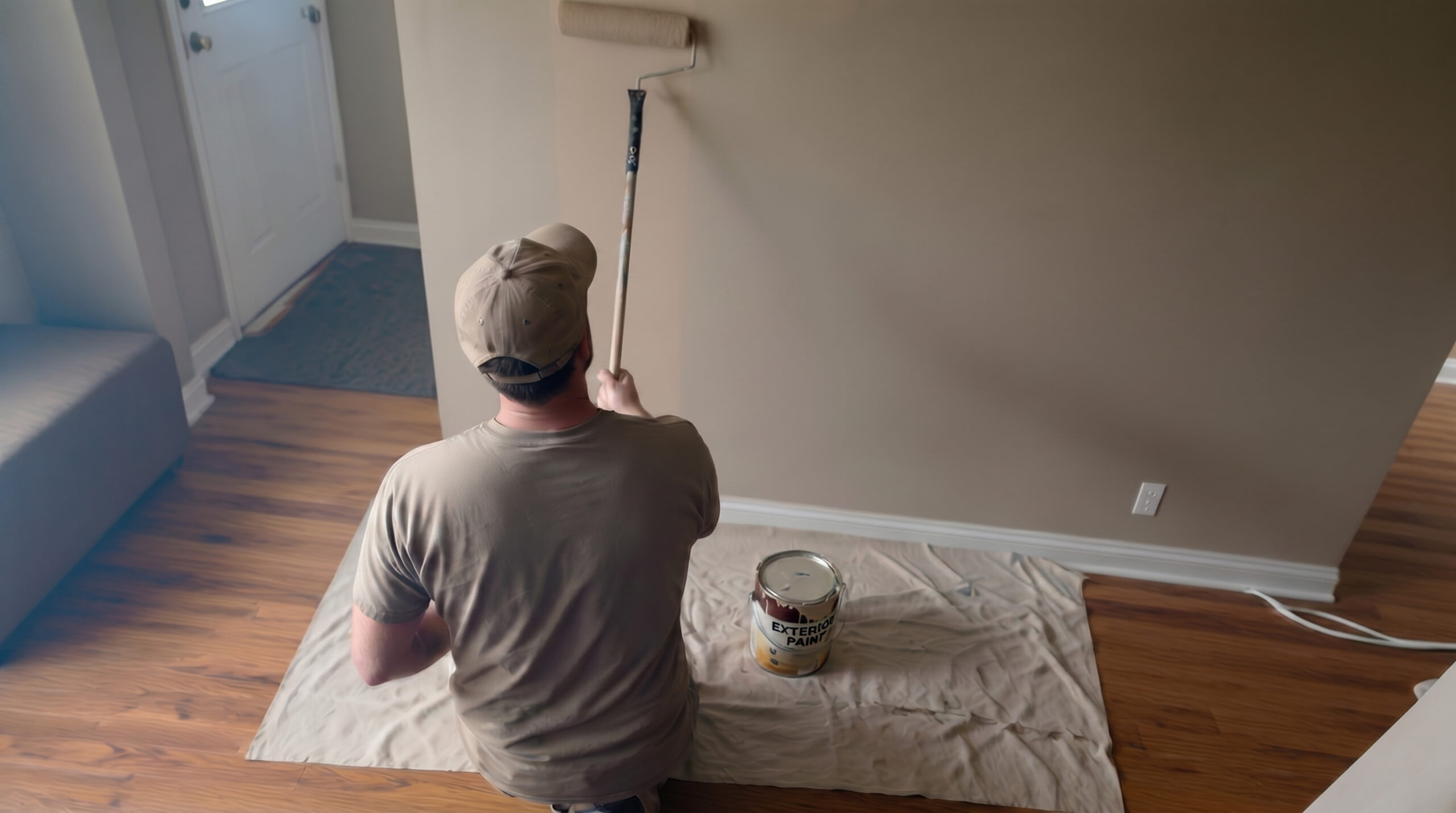
That half-empty can of exterior paint in your garage looks like a free shortcut. The color works, the can is already open, and buying new interior paint feels wasteful.
I have heard this from dozens of homeowners over the years, and the logic makes sense on the surface.
The problem is that exterior paint is built with chemicals and resins meant for open air, not for the enclosed rooms where your family sleeps and eats.
Using it indoors poses real health risks, results in a poor finish, and means you will likely redo the job within months.
This guide covers what happens when exterior paint is applied to interior walls, why professionals advise against it, and what to use instead.
Can You Use Exterior Paint Inside?
No, exterior paint should not be used inside your home.
Even though it will still go on the wall and appear to dry normally, that does not mean it is safe or suitable for indoor use.
The biggest concern is not how the paint looks on day one. It is the chemical emissions you cannot see or fully smell.
Exterior paint releases volatile organic compounds (VOCs) at levels designed for outdoor dispersal. Inside a closed room, those same compounds build up in the air your family breathes.
So while it may seem like a money-saving move, it is a mismatch between the product’s design and the environment where it ends up.
Why People Think Exterior Paint Can Be Used Indoors
It is easy to assume paint is interchangeable because both interior and exterior products look similar in the can. The confusion usually comes from cost-saving habits and misunderstood product labeling.
- It looks like a waste-saving option: Leftover exterior paint feels too valuable to throw away, so using it indoors seems like a practical way to avoid waste and save money.
- It appears stronger and more durable: Because exterior paint is labeled as tough and weather-resistant, many people assume it will automatically perform better inside the home as well.
- It still “works” on the wall: Exterior paint applies smoothly and covers surfaces well, so at first glance it appears to be functioning exactly as expected indoors.
- Misunderstanding paint labels: Many DIY users do not realize that “interior” and “exterior” labels refer to chemical formulation and safety design, not just where the paint is commonly used.
How Is Exterior Paint Different from Interior Paint?
1. Designed for Different Environments
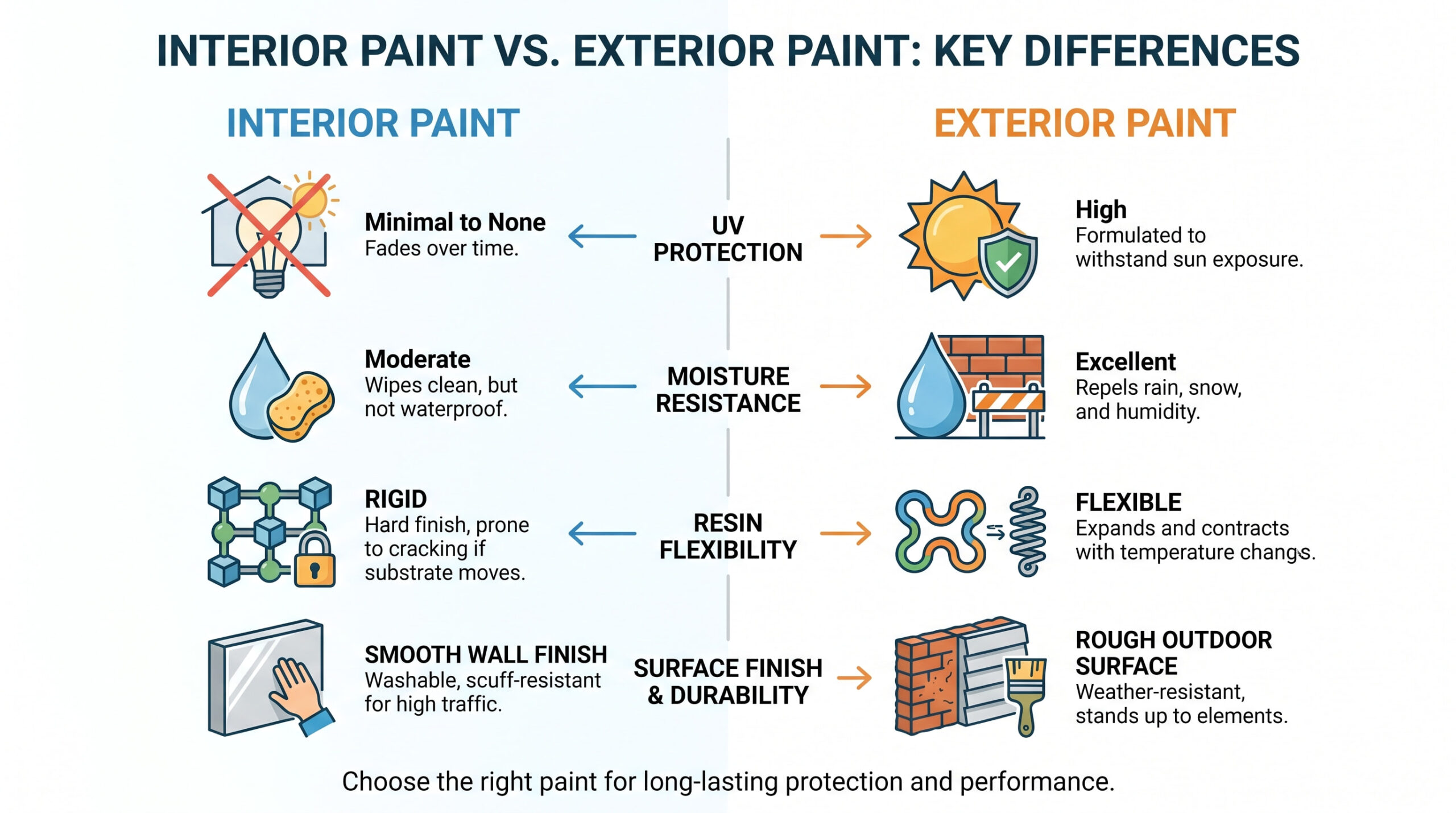
Exterior paint is designed to withstand outdoor conditions such as rain, sunlight, wind, and temperature fluctuations. Interior paint is made for stable indoor environments where weather resistance is not needed.
This difference in purpose shapes every part of their formulation. What works outside is not optimized for enclosed indoor spaces.
2. Chemical Formulation and Additives
Exterior paint contains stronger chemical additives, such as UV protectants, mildew-resistant agents, and higher levels of solvents. Interior paint uses milder formulations designed to reduce emissions and improve indoor safety.
These differences directly affect how each paint behaves after application. Indoor spaces require lower chemical intensity for safe long-term exposure.
3. VOC Levels and Air Quality Impact
Exterior paint generally contains higher levels of volatile organic compounds compared to interior paint. These compounds can be released into the air during and after drying.
Indoors, limited ventilation allows these emissions to linger longer. Interior paint is formulated to keep VOC levels low for healthier indoor air quality.
4. Durability vs Surface Comfort
Exterior paint is built for durability under harsh environmental stress, prioritizing resistance to fading and moisture. Interior paint focuses more on smooth application, easy cleaning, and consistent appearance.
While exterior paint may seem tougher, that toughness is unnecessary inside the home. Indoor walls require comfort and visual refinement, not weather resistance.
The difference between ceiling and wall formulas alone shows how much indoor paint performance varies by surface, and exterior formulas are even further removed from those standards.
5. Adhesion and Surface Compatibility
Exterior paint is designed to bond with rough outdoor materials like brick, wood, and stucco. Interior surfaces such as drywall and plaster have different absorption and texture characteristics.
Because of this mismatch, exterior paint may not adhere as effectively indoors. Over time, this can lead to peeling or uneven wear.
6. Drying Behavior and Finish Quality
Exterior paint is formulated to dry in open-air conditions with natural airflow and environmental exposure. Indoors, restricted ventilation can slow curing and affect how the paint sets.
Interior paint is optimized for controlled indoor drying, resulting in a smoother and more uniform finish. Exterior paint may appear less consistent under indoor lighting conditions.
What Are VOCs and Why Do They Matter Indoors? VOC stands for Volatile Organic Compound. These are chemicals in paint that evaporate into the air as the paint dries and continue to do so long after. Common VOCs found in exterior paint include benzene, formaldehyde, toluene, and xylene. According to the EPA, indoor VOC levels are already 2 to 5 times higher than outdoor levels under normal conditions. During paint application, those levels can spike to 1,000 times the outdoor concentration. Exterior paint continues to release VOCs even after it appears and feels dry. |
What Happens When You Use Exterior Paint Inside?
The concerns go well beyond a strong smell. Here is what actually happens when exterior paint ends up on interior walls.
1. Serious Health Risks from Indoor VOC Exposure
This is the main reason to keep exterior paint outdoors.The EPA links indoor VOC exposure to headaches, nausea, eye and throat irritation, loss of coordination, kidney and liver damage, and central nervous system issues.
The risk is greater in homes with babies, elderly people, pets, or anyone with asthma or respiratory conditions.
The fumes do not stop once the paint looks dry. Off-gassing can continue for weeks or months in poorly ventilated spaces.
2. Improper Drying and Curing
Exterior paint is formulated to dry in open air with natural airflow. Inside a home, ventilation is limited.
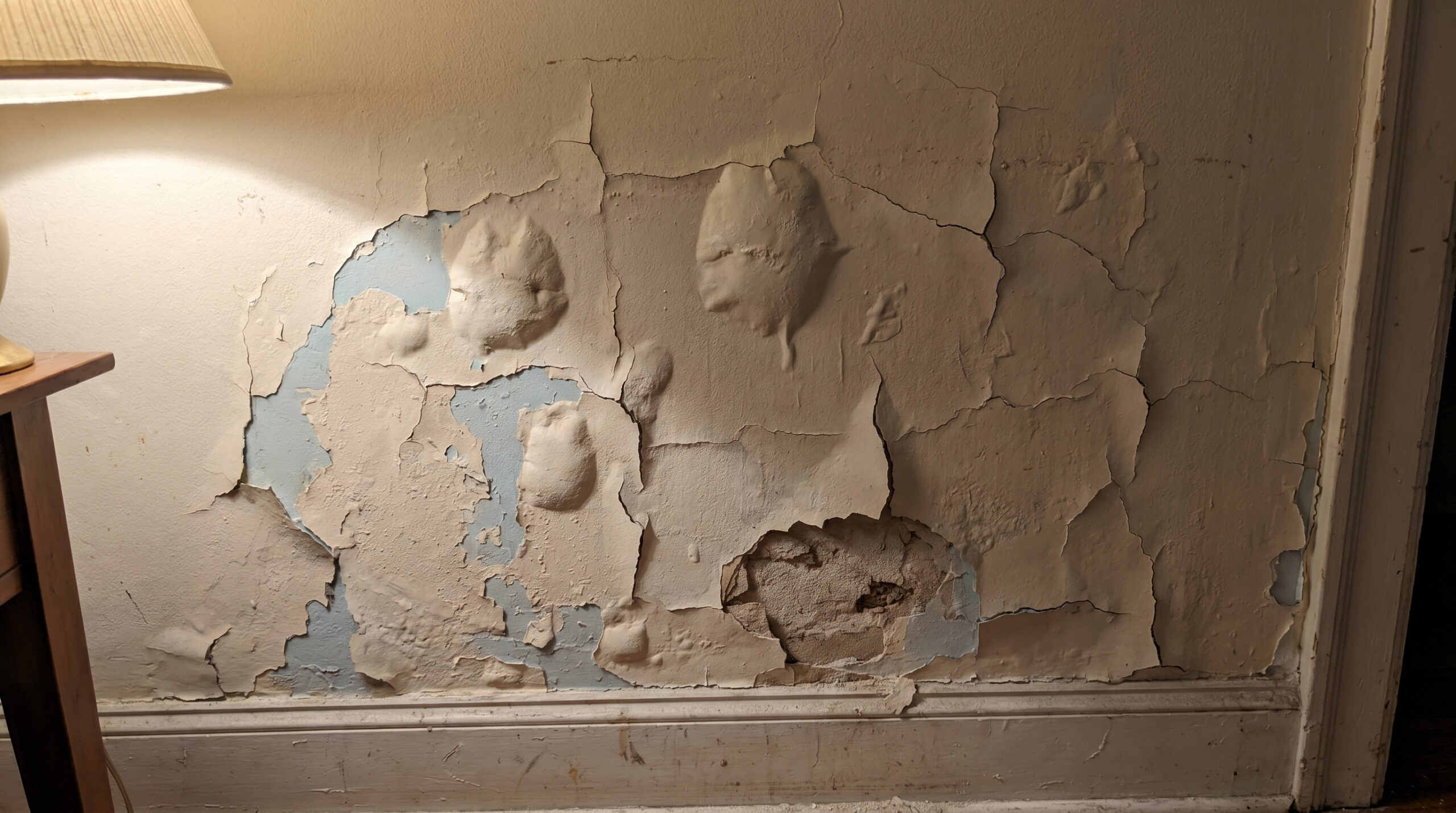
This causes a chain of problems: The paint takes far longer to dry, it may never fully cure on an interior wall, and The surface can stay tacky even after it feels dry to The touch. Within weeks, you may see blisters, cracks, and peeling.
3. The finish will look uneven
You might expect a tough outdoor paint to hold up even better inside. It does the opposite. Exterior paint lacks the flow and leveling agents that give interior walls a smooth, even finish.
Brush marks stay visible, patches look uneven, and the surface scuffs easily. The result is walls that look worse than when you started.
I once walked a client through a nursery she had painted with leftover deck paint. The walls were patchy under the overhead light, and the smell was still noticeable two weeks later.
We primed the whole room and repainted with a zero-VOC interior formula. The difference was immediate.
4. It causes persistent odors
Outdoors, strong chemical smells from paint fade quickly in The open air. indoors, they stay. The odor from exterior paint can linger for weeks, especially in rooms with limited ventilation.
That smell indicates that chemicals are still being released into the air. No candles or air fresheners; address the source.
5. It does not stick well to interior surfaces
Exterior paint is designed to bond to rough outdoor materials such as wood, brick, and stucco. Indoor drywall and plaster are different surfaces, and exterior paint binders do not adhere well to them.
The result is peeling, bubbling, and poor adhesion over time. you could end up having to redo the job in a matter of months.
What Can Happen When You Ignore the Warnings?
Paint fumes are not a minor inconvenience. The research is detailed on this.
A medical case published on PubMed documents an adult male who inhaled paint solvent vapors in A confined space.
He developed central nervous system damage, severe heart and lung problems, and kidney failure. He died 11 days after exposure.
The researchers concluded that enclosed spaces with poor ventilation pose an extreme risk of VOC overexposure.
This was an industrial case involving exposure to concentrated solvent, not typical household painting.
The point is that ventilation matters, and using high-VOC products in closed rooms moves you closer to that risk spectrum, not further from it.
What to Do If You Already Used Exterior Paint Inside?
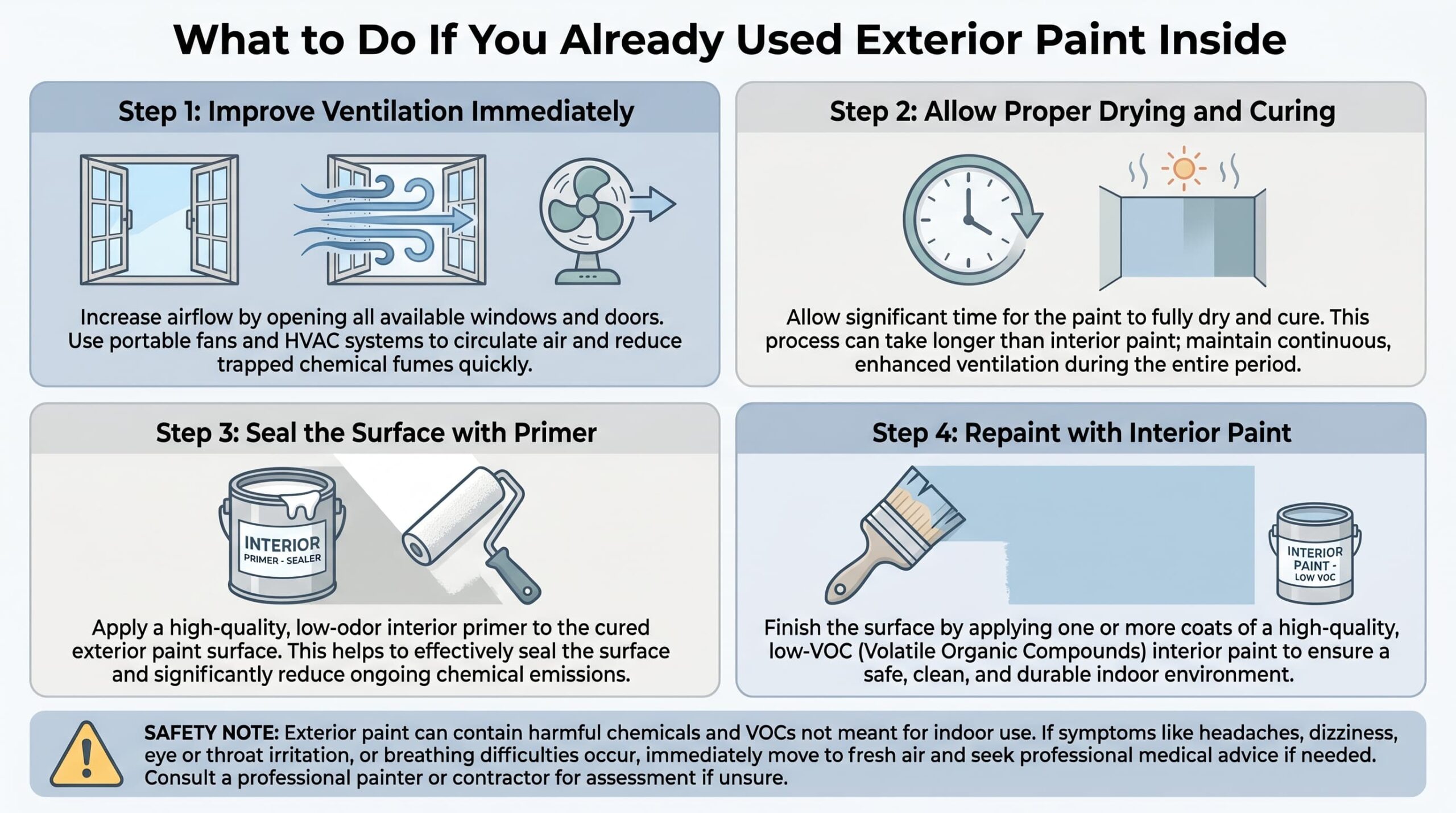
If you have already painted a room with exterior paint, act quickly. The fix is straightforward.
- Ventilate the space. Open windows and run fans to move VOCs out as fast as possible. Do this immediately and keep it going for several days.
- Prime over the exterior paint. Once the paint has dried, apply a good-quality interior primer over the entire surface. This seals the exterior paint and stops further off-gassing.
- Repainting with interior paint. After priming, apply two coats of a low-VOC or zero-VOC interior paint. This covers the exterior paint and returns the surface to a safe, properly finished state.
If you or anyone in the home has trouble breathing, dizziness, or persistent headaches after exposure, get fresh air and contact a medical professional right away.
Can You Use Exterior Paint in a Garage?
A garage is better ventilated than a bedroom or living room, which somewhat reduces the VOC risk.
If your garage is detached and unheated, exterior paint is more acceptable. For attached garages or spaces where you spend regular time working, interior paint is still the safer and better-performing choice.
What to Do with Leftover Exterior Paint Instead
If you have partial cans sitting in storage, there are better uses than bringing them inside your home:
Touch up fences, deck railings, or outdoor furniture. Refresh the exterior of a garden shed or storage unit. Paint planters, outdoor benches, or backyard play structures. Donate unopened cans to local schools, community theaters, or Habitat for Humanity ReStores. If the paint is too old or dried out, contact your local waste facility for proper disposal.
Exterior Paint vs Interior Paint: Side-By-Side
Here Is a Straightforward Comparison of The Two Types:
| Feature | Exterior Paint | Interior Paint |
|---|---|---|
| Voc Level | High | Low to Zero |
| Resin Type | Soft, Flexible | Rigid |
| Finish Quality Indoors | Patchy, Uneven | Smooth, Consistent |
| Drying Time Indoors | Very Slow | Fast |
| Adhesion to Drywall | Poor | Excellent |
| Odor Indoors | Strong, Lasting | Minimal |
| Safe for Families? | No | Yes |
| Best Used For | Siding, Fences, Trim | Walls, Ceilings, Cabinets |
The Best Interior Paints to Use Instead
Now that You Know What to Avoid, Here Is What to Actually Buy.
What Certifications Should You Look For?
Before Buying Interior Paint, Check the Label for These Verified Safety Standards:
- Zero-VOC: Less than 5 Grams of Vo Cs per Liter
- Low-VOC: Less than 50 Grams per Liter
- Green Guard Gold: Confirms VOC Emissions Below 220 Micrograms per Cubic Meter
- Green Seal Gs-11: Limits Vo Cs Plus Carcinogens, Phthalates, Heavy Metals, and Pfas
- USDA Certified Biobased: Confirms Renewable, Plant-Based Content
These Are Verified Benchmarks, Not Marketing Labels.
Top Interior Paint Brands Worth Considering
Here Are the Most Trusted Options on The Market Right Now:
- Benjamin Moore Eco Spec / Aura: Zero Vo Cs, Zero Emissions, Green Seal Certified, and Asthma and Allergy-Friendly Certified. the Color Stays Zero-Voc Even After Tinting.
- Sherwin-Williams Emerald: Strong Performer for Mildew Resistance and Smooth Coverage, Especially in Bathrooms and Kitchens. It also works well for interior surfaces if you are thinking about a full bathroom renovation refresh.
- Behr Premium Plus Eco Mix: The First 100% Acrylic Paint to Earn a USDA Certified Biobased Label. Also, Zero-VOC and GreenGuard Gold Certified.
- Sherwin-Williams Pro Mar Zero-Voc: A Budget-Friendly Professional Option with Solid Zero-Voc Performance.
How to Match Paint Type to Each Room
Not Every Room Calls for The Same Product. Here Is a Practical Guide:
| Room | Best Finish | Key Feature Needed |
|---|---|---|
| Bedroom / Nursery | Flat or Eggshell | Zero-Voc |
| Living Room | Eggshell or Satin | Washable, Low-Odor |
| Kitchen | Satin or Semi-Gloss | Moisture and Stain Resistant |
| Bathroom | Semi-Gloss | Mildew Resistant |
| High-Traffic Hallway | Satin | Scrubbable, Durable |
Final Thoughts
So, Can You Use Exterior Paint Inside? Technically, It Will Go on The Wall.
But the Health Risks Are Real. the Finish Will Disappoint. The fumes will stay. And the paint may start peeling before the season is out.
The Right Move Is Straightforward: Pick a Zero-VOC Interior Paint with A Green Guard or Green Seal Certification and Match the Finish to The Room.
Your Walls Will Hold Up Better, and The Air in Your Home Will Stay Cleaner.
Frequently Asked Questions
Can I Use Sherwin-Williams Exterior Paint Indoors?
No, it is not recommended. Exterior paint can emit higher VOC levels indoors and affect indoor air quality, so interior paint is the safer choice.
Can I Use Exterior Paint Inside My Bathroom?
It is not advised. Bathrooms trap moisture and fumes, so interior mildew-resistant paint is a safer and more suitable option.
How to Clear Lungs After Inhaling Paint Fumes?
Move to fresh air immediately, drink plenty of water, and breathe slowly if symptoms like dizziness or chest tightness persist; see a doctor right away.