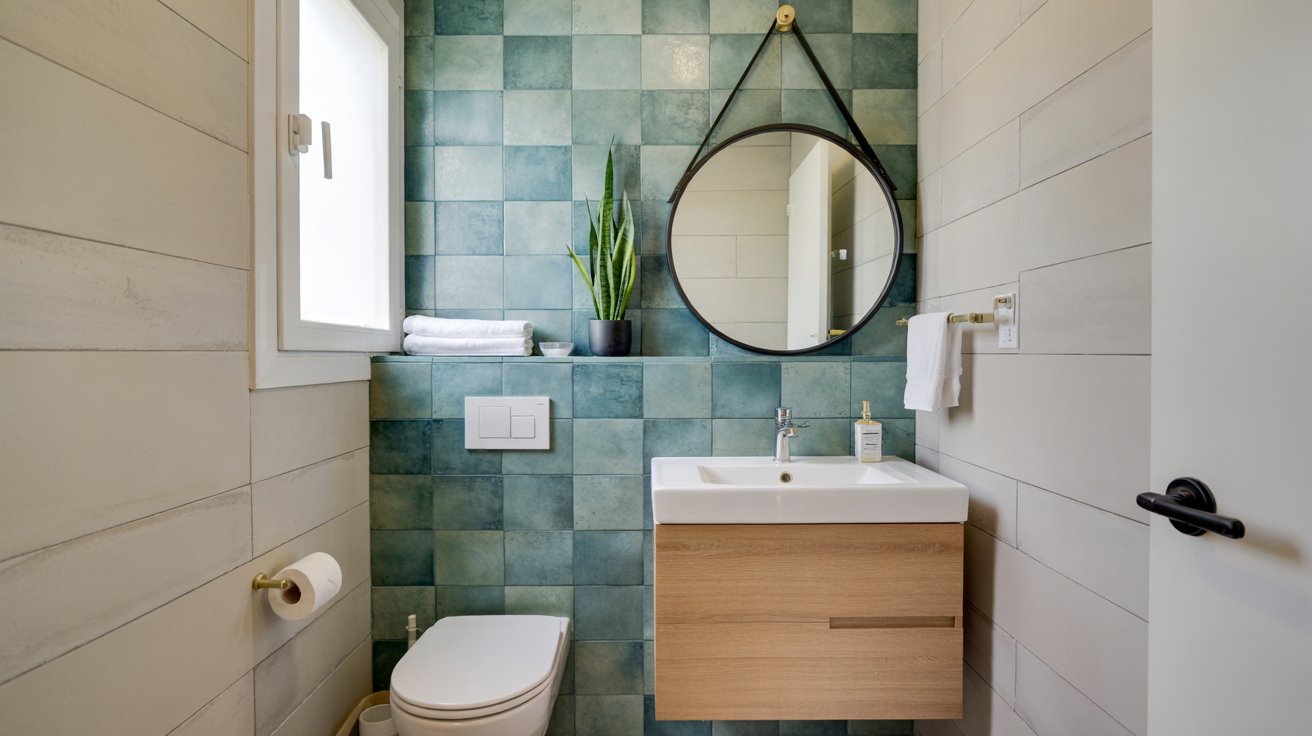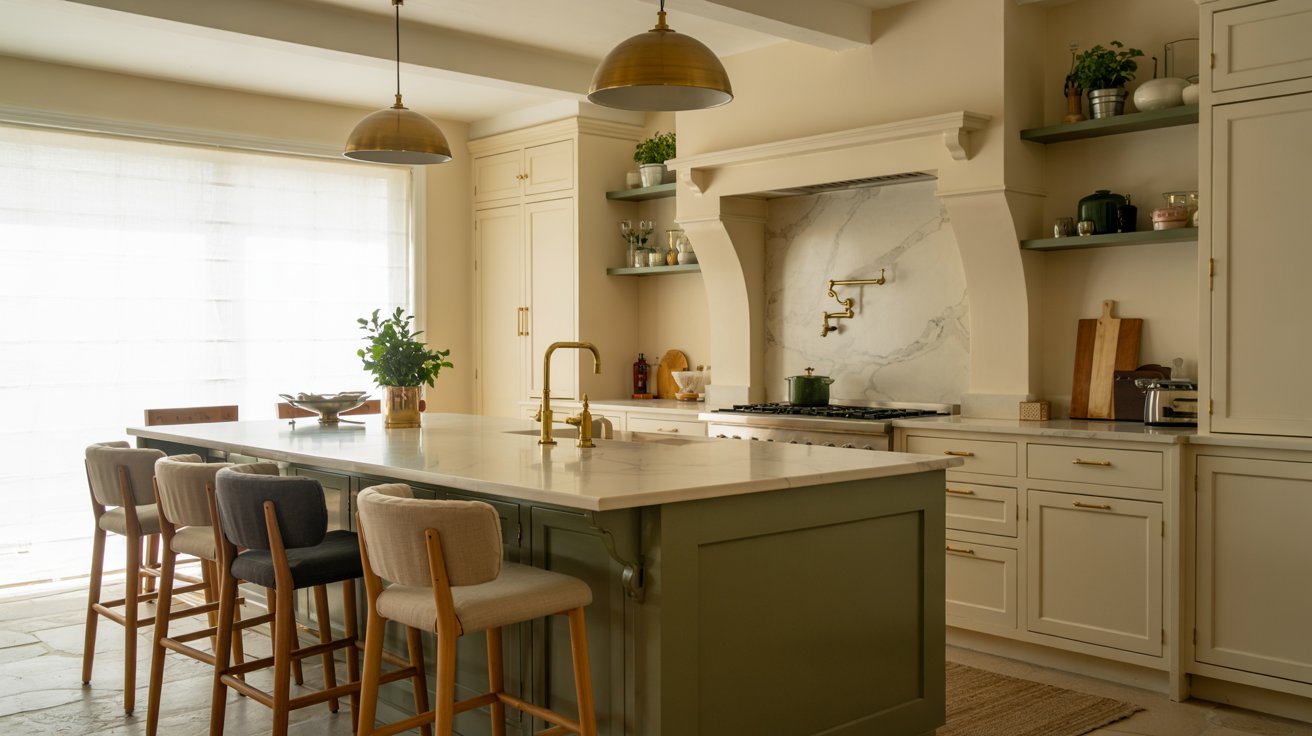
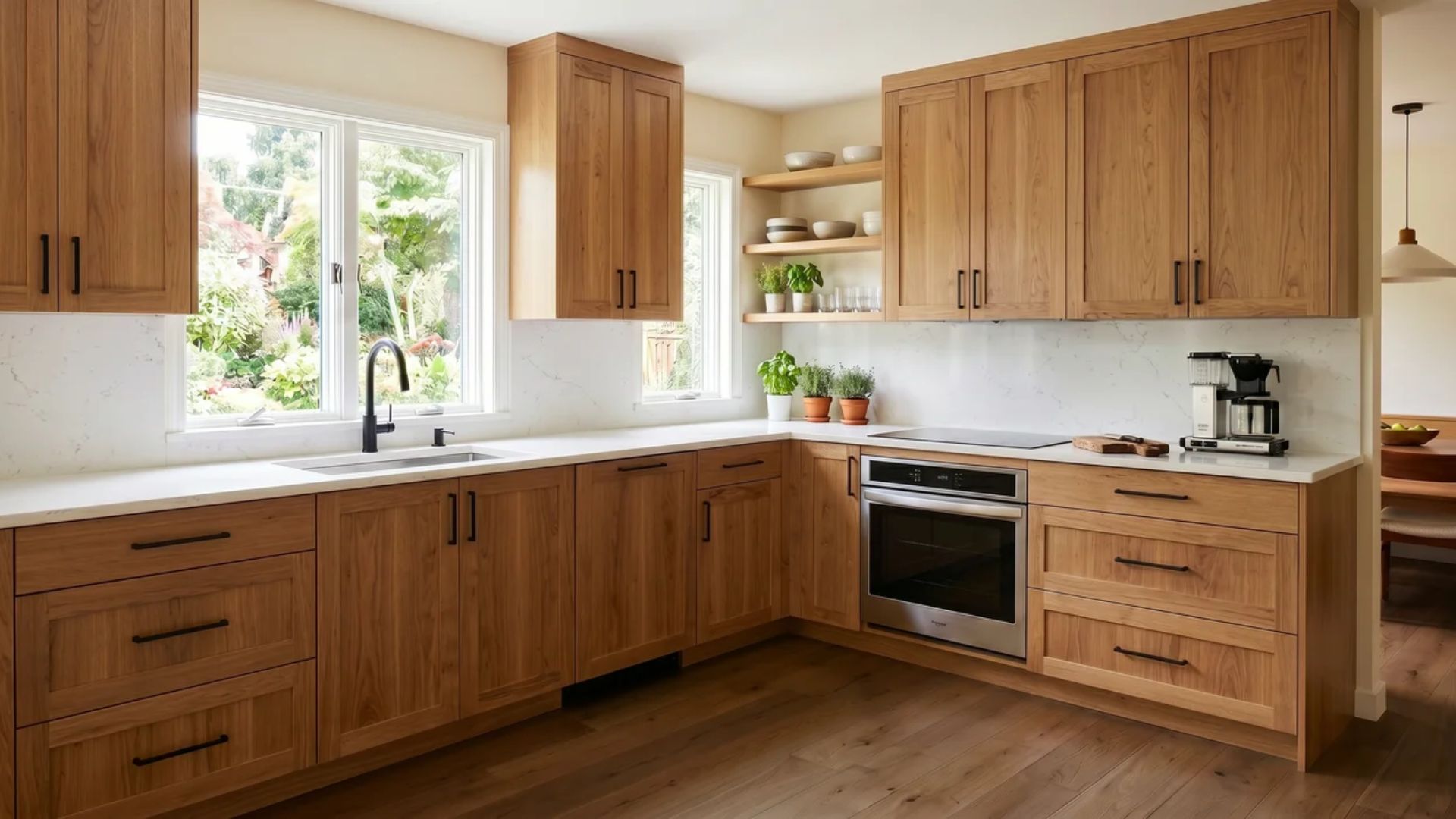
Flip through any kitchen magazine, and the pattern is clear. Clean cabinet doors sit flush. No gaps. No visible frames breaking up the layout.
That’s full overlay cabinets doing their job. Cabinet overlay types rarely come up until you’re mid-renovation, staring at a quote that makes no sense.
Partial overlay? Standard overlay? Full overlay? What does any of it mean? This post breaks it all down.
You’ll learn what full-overlay cabinets are, how they stack up against other types, which materials and styles work best, and what they actually cost.
By the end, you’ll know whether full overlay cabinets belong in your kitchen.
What Are Full Overlay Cabinets?
Full-overlay cabinets have doors and drawer fronts designed to cover almost the entire face frame of the cabinet box.
When closed, only a very small gap, usually about 1/8 inch, remains between the doors and drawers. This creates a smooth, seamless appearance that is often associated with modern and contemporary kitchen designs.
Key Features of Full Overlay Cabinets:
- Maximum face frame coverage: The doors cover most of the cabinet frame, leaving very little of the frame visible.
- Minimal gaps: Small spaces, typically 1/8 inch or less, separate adjacent doors and drawer fronts.
- Compatible with different cabinet styles: They can be used with both framed and frameless cabinet boxes.
- Clean, streamlined appearance: The nearly continuous surface creates a sleek, uniform look throughout the entire cabinet run.
- Increased storage access: Larger door openings can make it easier to reach items inside the cabinets.
Because of their polished appearance and efficient use of space, full overlay cabinets are a popular choice for kitchen remodels that aim for a modern, high-end finish.
Design Tip: Full overlay cabinets make small kitchens feel larger. When the eye sees fewer frame lines, the space reads as more open and less broken up.
Types of Full Overlay Cabinets
Full overlay cabinets come in several types, each built differently and suited to a different kitchen style or budget. Knowing the difference helps you pick the right one before you spend a dollar.
1. Framed Full Overlay Cabinets
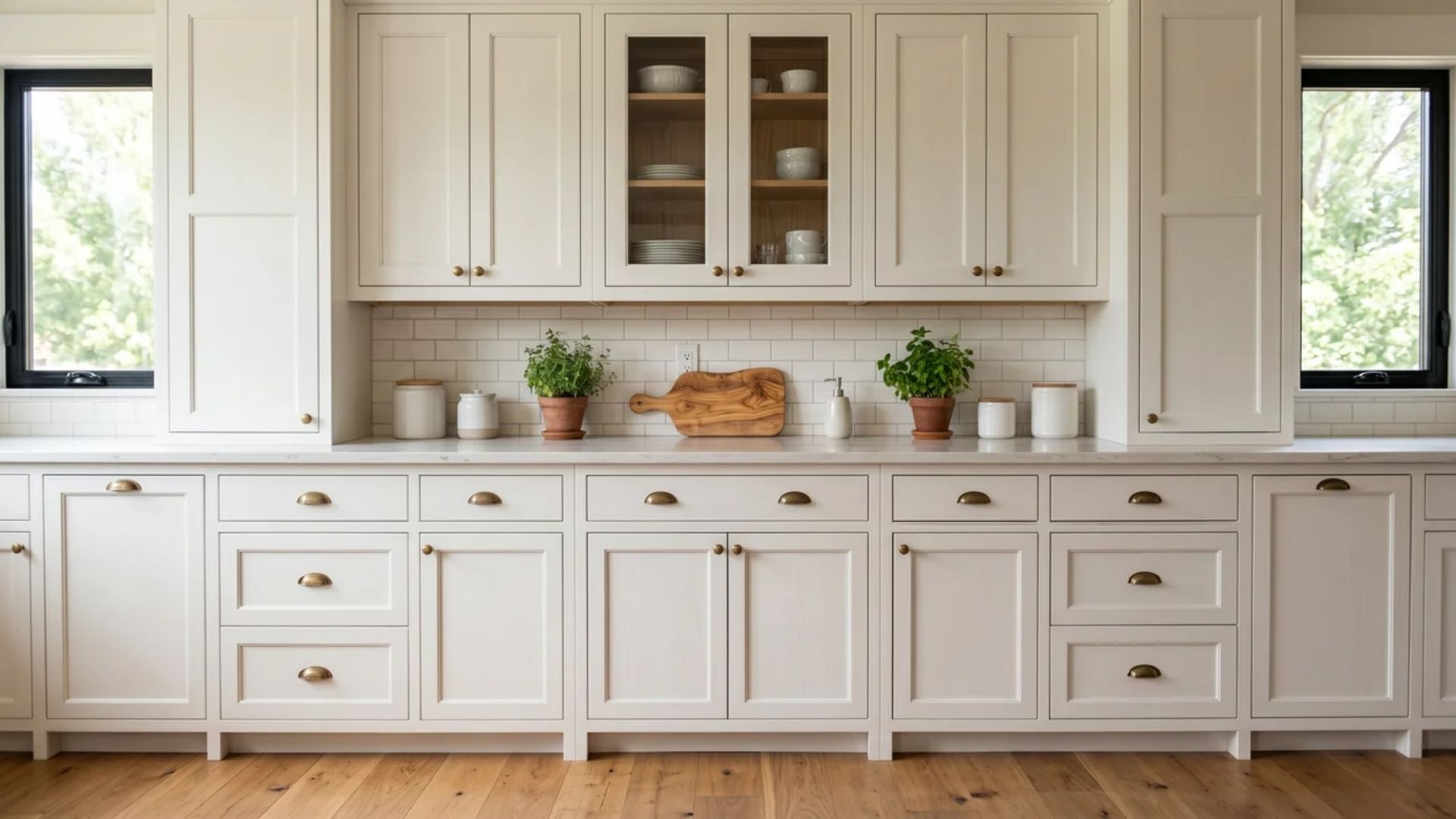
Framed cabinets have a solid wood face frame attached to the front of the cabinet box.
The full-overlay door covers most of the frame, leaving only a small gap visible. This is the most common cabinet construction in North America and works well in transitional and traditional kitchen cabinet styles.
Key features:
- Adds structural strength to the cabinet box
- Slightly less interior access than frameless options
- More forgiving to install because the face frame helps cover small errors
- Works well with shaker and raised panel door styles
2. Frameless Full Overlay Cabinets
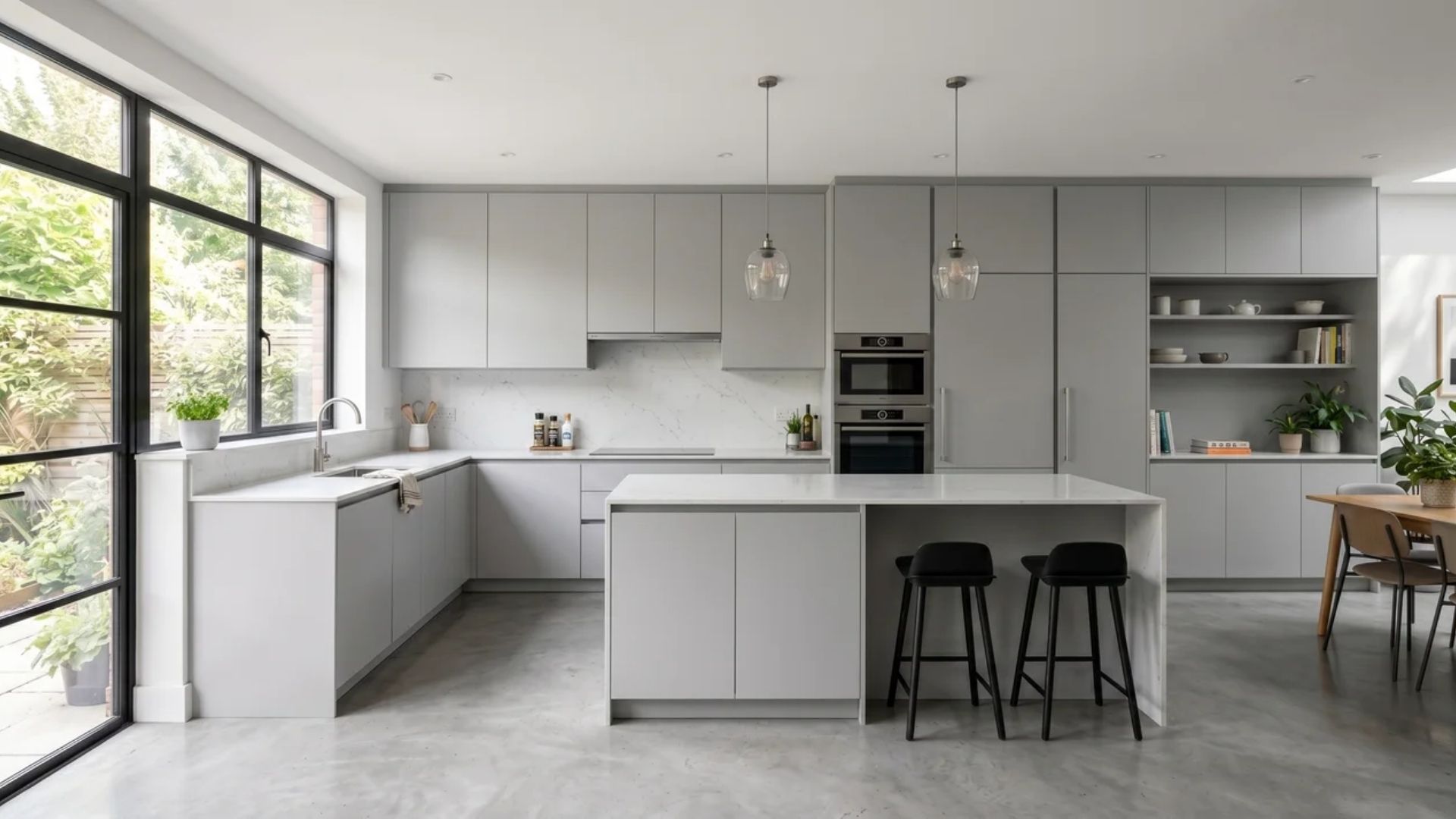
Frameless cabinets, also called European-style cabinets, have no face frame. The full overlay door mounts directly onto the cabinet box using European hinges.
The result is a cleaner, more minimal look with doors sitting very close together.
Key features:
- More interior storage space because no face frame blocks access
- Gaps between doors as small as 1/16 inch
- Requires very precise installation because there is no face frame to cover small errors
- Standard in European kitchen design, growing fast in North American kitchens
3. Full Overlay Shaker Cabinets
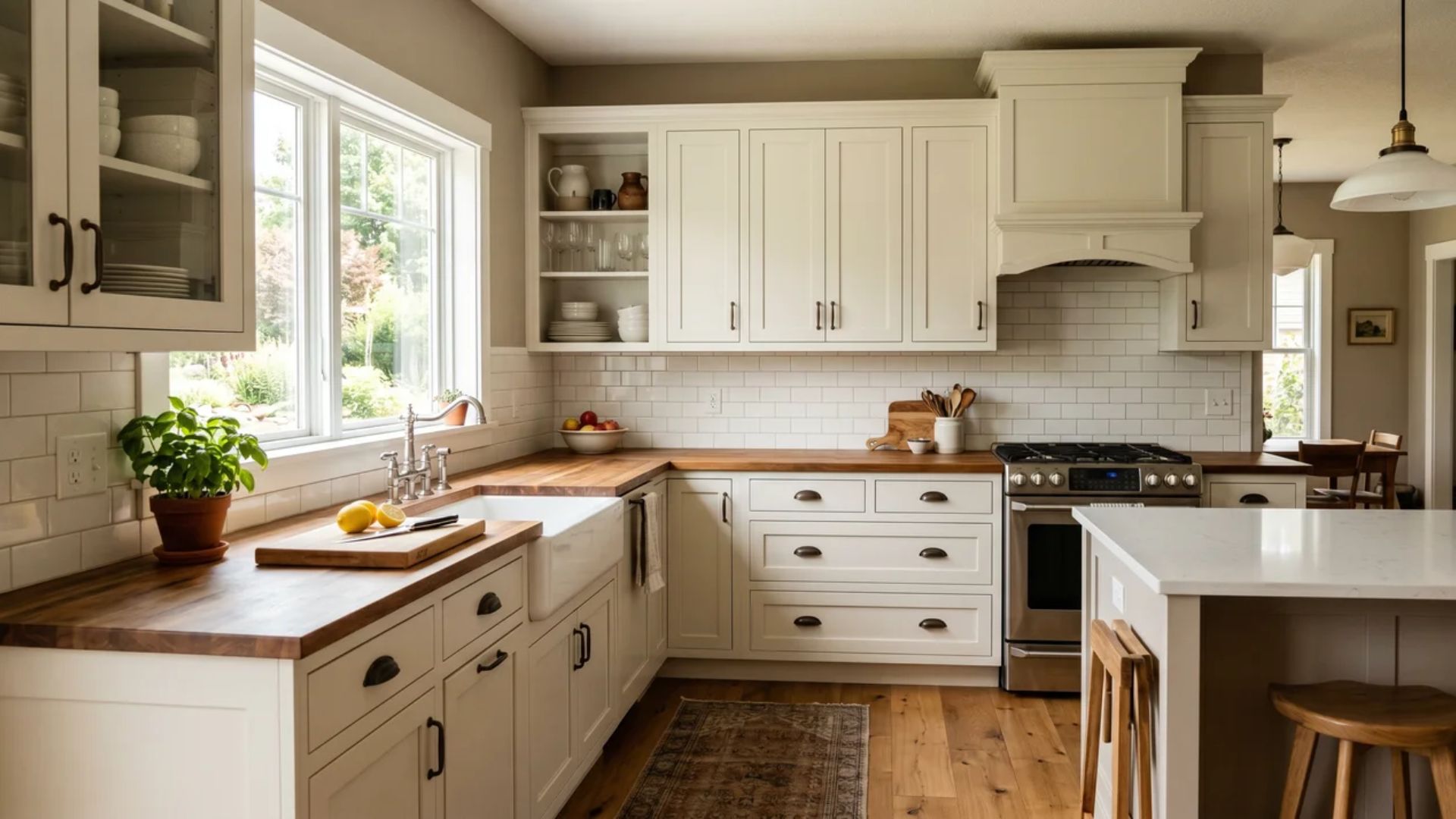
Shaker-style full overlay cabinets are the most popular choice in kitchens today. The door has a simple recessed center panel with a clean, flat frame around it.
It works across more kitchen styles than any other door type. If you’re deciding between shaker cabinets and traditional styles, shaker gives you the widest range of pairing options.
Key features:
- Works in modern, farmhouse, transitional, and coastal kitchen styles
- Available in painted, stained, and two-tone finishes
- One of the most widely available full overlay door styles
- Pairs well with both traditional hardware pulls and modern bar handles
4. Flat Panel (Slab) Full Overlay Cabinets
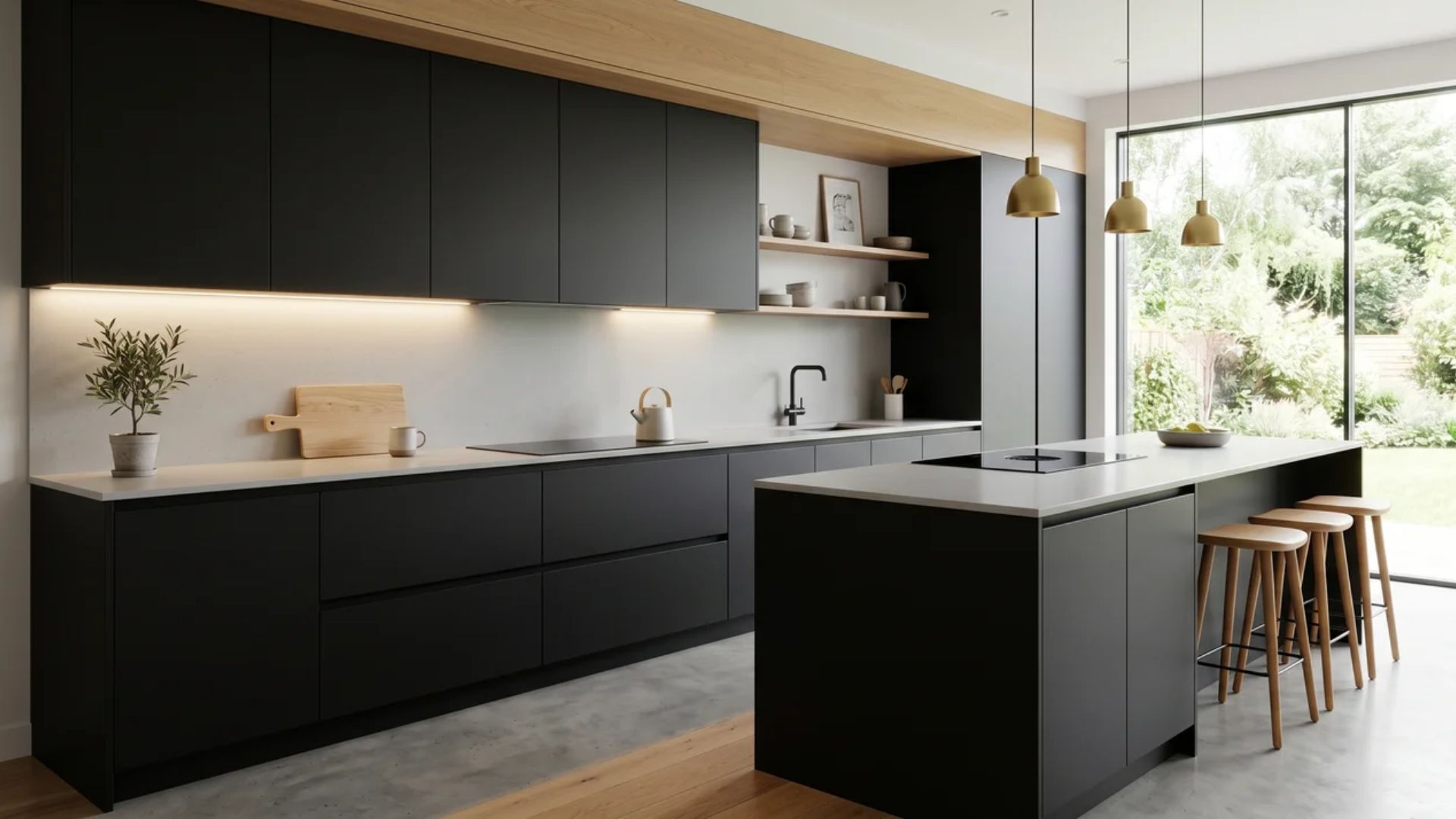
Flat panel or slab doors have no detail, no profile, and no raised or recessed center. The entire door face is one flat surface. This is the cleanest, most minimal full overlay option available.
Key features:
- Works best in modern, contemporary, and Scandinavian kitchen styles
- Often paired with handleless push-to-open hardware for a fully flush look
- Available in high-gloss, matte, and textured finishes
- Very easy to wipe clean with no grooves or edges to collect grease
A note on inset cabinets: Inset cabinets are not a type of full overlay. The door sits inside the frame opening, flush with the face frame, rather than covering it from the outside. Inset construction costs more, requires tighter tolerances, and gives a different look.
For a deeper comparison, see the inset vs overlay cabinets breakdown.
Full Overlay vs. Partial and Standard Overlay Cabinets
Not sure which overlay type fits your kitchen? Here’s how each one works and which suits your space best. The difference comes down to one thing: how much of the face frame the door covers.
What Are Partial Overlay Cabinets?
A partial overlay cabinet has a door that covers only part of the face frame. When the door closes, you can clearly see the frame around it, typically 1/2 to 1 inch on each side.
What Is Standard Overlay?
The standard overlay sits between the partial overlay and the full overlay. The door covers about 1/2 inch of the frame on each side, more than minimal partial coverage, but still leaves a noticeable portion of the frame visible.
Side-by-Side Comparison of Full, Partial, and Standard Overlay Cabinets
Feature | Full Overlay | Standard Overlay | Partial Overlay |
Frame visibility | Minimal | Moderate | High |
Gap between doors | 1/8 inch | 1/4–1/2 inch | 1/2 to 1 inch |
Cost | Higher | Mid-range | Lower |
Best for | Modern, contemporary | Transitional | Traditional, budget |
Installation precision | High | Medium | Lower |
Which Overlay Type Should You Choose?
- Choose a full overlay if you want a modern, clean look and don’t mind paying more for it
- Choose a standard overlay if you want a neater finish than partial, but need to keep costs down
- Choose a partial overlay if you’re on a tight budget or have a traditional-style kitchen
Installation and Hardware for Full Overlay Cabinets
Full overlay cabinets need specific hardware. Standard hinges will not fit. Using the wrong hardware is one of the most common mistakes during installation.
Hinges for Full Overlay Cabinets:
Full overlay doors need a full-overlay European hinge. This concealed hinge mounts inside the cabinet box and stays completely hidden when the door is closed.
What to look for:
- Soft-close feature so doors close quietly without slamming, reducing wear over time
- Six-way adjustment (up/down, left/right, in/out) for perfect door alignment
Pro Tip: European hinges let you adjust full overlay cabinet doors without removing them. A simple turn of the adjustment screw brings a misaligned door back into place in minutes. You only need a basic Phillips screwdriver.
Drawer Slides for Full Overlay Cabinets:
For drawers with full overlay fronts, use undermount drawer slides. These mount beneath the drawer box, stay completely hidden, and handle heavy loads well.
- Side-mount slides also work, but are more visible when the drawer opens
- Soft-close undermount slides add a smooth, quiet close to every drawer
- For heavy pots and pans, choose slides rated for at least 100 lbs
Tips for Proper Installation
Full-overlay cabinets require more precise installation than partial-overlay cabinets. Here’s what to check:
- Level your cabinet boxes first. Even a slight tilt throws off door alignment
- Use a consistent gap spacer. A 1/8 inch spacer card helps keep gaps even
- Install hinges before hanging doors by attaching cups to doors first, then clipping to the mounting plate inside the box
- Check plumb and square on every box. Small errors multiply across a long cabinet run
- Let the boxes settle before final adjustments, because temperature and humidity shift wood slightly
Pro Tip: Always install upper cabinets before lower cabinets. It gives you easier access and protects lower boxes from damage during installation.
Durability note: Full overlay construction itself does not affect cabinet durability. That depends on the cabinet box material. Plywood boxes hold up better than particleboard over time, regardless of overlay type. If you are planning a broader renovation, a kitchen remodel checklist helps keep material and hardware decisions organized.
Adjustments and Maintenance
One real advantage of full overlay cabinets with European hinges is how easy they are to adjust.
| Problem | Fix |
|---|---|
| The door is sitting too low | Turn the height screw on the hinge upward |
| Door not closing flush | Adjust the depth screw forward or back |
| The gap is uneven on one side | Turn the side screw left or right |
| Door squeaking | Apply a small amount of hinge lubricant |
Maintenance routine:
- Wipe doors weekly with a soft, damp cloth. Avoid soaking the surface
- Use mild dish soap for grease near the stove. Harsh cleaners strip finishes
- Check and adjust hinges every 1 to 2 years
- Tighten loose screws on hinges and pulls as soon as you notice them
- Touch up paint chips quickly to stop moisture from getting under the finish
- Keep standing water away from wood cabinet doors near the sink
Pros and Cons of Full Overlay Cabinets
Full overlay cabinets look sharp and work well, but they are not the right fit for every kitchen or budget. Before you commit, here’s an honest look at what you gain and what you give up.
| Category | Pros | Cons |
|---|---|---|
| Aesthetics | Clean, continuous look across the cabinet run | Not ideal for ornate or very traditional kitchens |
| Functionality | Wider door openings for easier access | Small alignment errors show more than partial overlay |
| Hardware | European hinges adjust easily and last long | Soft-close hinges and undermount slides add to the cost |
| Cleaning | Fewer frames mean fewer edges collecting grease | Damaged doors need exact measurements to replace |
| Style Range | Works from modern to farmhouse designs | Can look out of place in classic or antique-style homes |
| Installation | A precise fit gives a high-end finish | Requires careful leveling and measuring throughout |
| Cost | Looks custom without full custom pricing | Costs more than partial overlay options |
Cost of Full Overlay Cabinets
Full-overlay cabinets cost more than partial-overlay cabinets. But the price gap is not always as wide as expected, and there are real ways to get the look for less.
Average Price Ranges:
| Cabinet Type | Cost Per Linear Foot (Approx.) |
|---|---|
| Stock full overlay (RTA) | $150 to $300 |
| Semi-custom full overlay | $300 to $600 |
| Custom full overlay | $600 to $1,200+ |
Note: These are approximate ranges for cabinet materials only. Installation, countertops, and hardware are separate costs.
Conclusion
Full overlay cabinets give your kitchen a cleaner, more refined look by covering most of the face frame.
They work across a wide range of styles, from modern flat-panel to classic shaker, and offer real functional benefits like wider door openings and easy hinge adjustments.
They cost more than partial overlay and need more precise installation. But for a serious kitchen update, the result is worth it.
If you’re still deciding between full overlay and other cabinet types, start by looking at the kitchens you love most.
Ready to plan your kitchen update? Leave your questions in the comments below.
Frequently Asked Questions
Are Full Overlay Cabinets Worth It?
Yes. Full overlay cabinets look sharp, last long, and add real value. They cost more but deliver a cleaner, more finished kitchen appearance.
Is Full Overlay Better than Half Overlay?
For modern kitchens, yes. Full overlay hides more of the face frame, creates cleaner lines, and gives your kitchen a more high-end look.
Do Full Overlay Cabinets Need Handles?
Not always. Slab-style full overlay doors can use push-to-open hardware for a handleless look. Shaker-style doors work better with pulls or knobs.